- FAQ
- 716
Decoding the Technical Parameters of Silicone Waterproof Coating: A Technical Guide for Engineers and Procurement Professionals
A detailed technical guide for engineers and procurement professionals on interpreting silicone waterproof coating parameters, understanding production process impact, avoiding common selection mistakes, and recognizing Chinese manufacturers' technological advantages.
1. Core Technical Parameters of Silicone Waterproof Coating
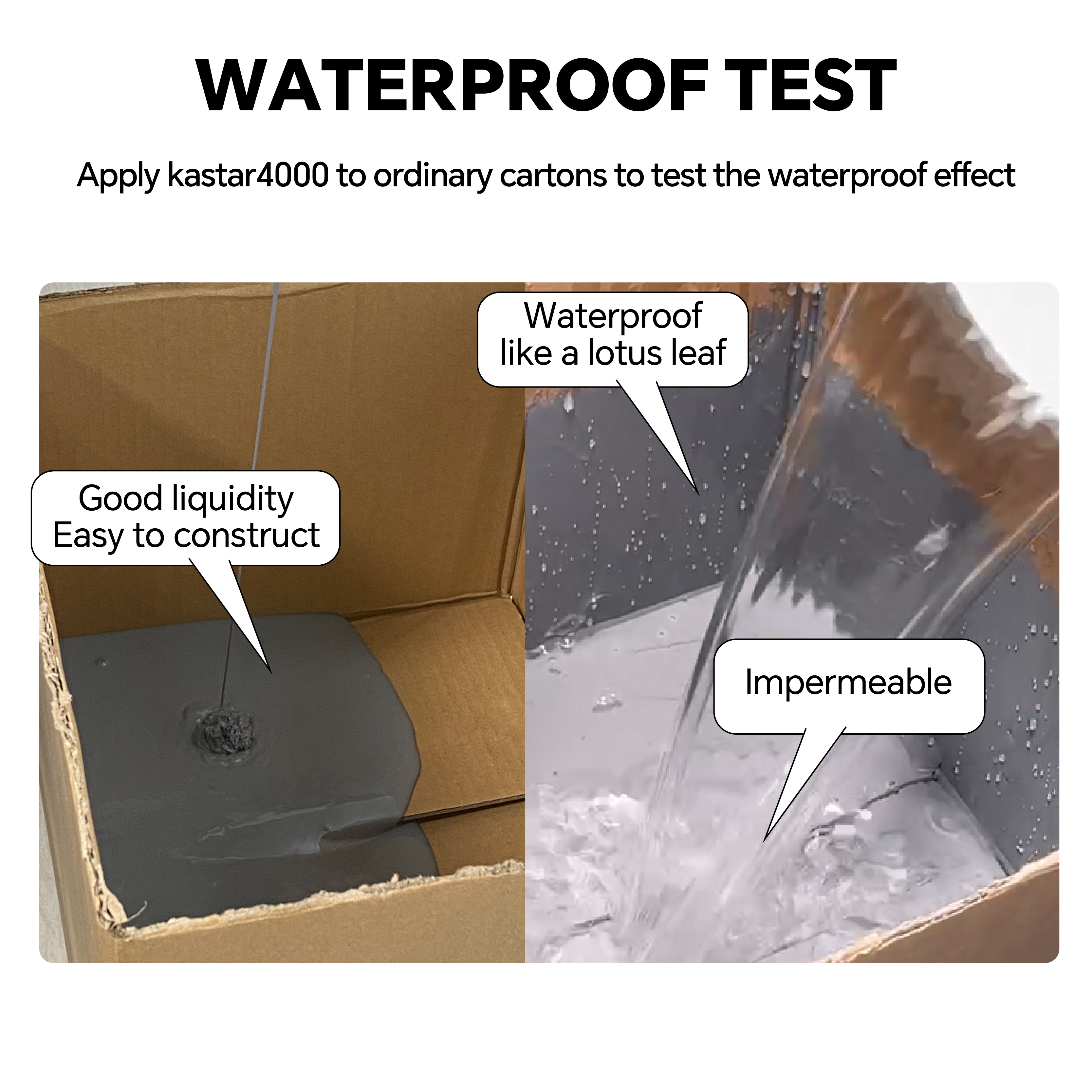
Silicone waterproof coatings are increasingly specified for long-term building protection. To correctly evaluate a product, procurement teams and engineers must understand several key parameters defined in product datasheets. The Kastar 4000 Silicone Waterproof Coating, for example, provides a reference set of typical values for analysis.
- Solid Content (≥98%): High solid content indicates less solvent or water, resulting in a thicker film per coat, higher coverage efficiency, and lower VOC emissions. A 98% solid content coating cures primarily by moisture, leaving minimal shrinkage.
- Elongation at Break (≥200%): This measures the coating’s ability to stretch without cracking. A value of 200% or more allows the film to accommodate structural movements, thermal expansion, and minor substrate cracks. For roof applications, high elongation directly correlates with long-term leak prevention.
- Tensile Strength (≥1.2 MPa): Indicates the stress the coating can withstand before breaking. Combined with elongation, it ensures the film remains intact under wind uplift, foot traffic, or debris impact.
- UV Resistance (1,000 h no cracking/peeling): Silicone’s inherent UV stability is a major advantage. Accelerated weathering tests of 1,000 hours with no visible degradation confirm the coating’s suitability for outdoor exposure in high solar radiation regions.
- Operating Temperature Range (-80°C to 180°C): The wide range ensures performance in extreme climates, from freezing winters to hot roofs. Silicone maintains flexibility at low temperatures and thermal stability at high temperatures.
- Service Life (≥25 years outdoor): Based on accelerated aging and field data, high-quality silicone coatings can deliver maintenance-free waterproofing for over two decades, significantly reducing life-cycle costs.
When evaluating a coating, always cross-reference these parameters with the project’s climatic conditions, substrate type, and expected structural movement. A product with 98% solids and 200% elongation is generally suitable for most roof and exterior wall applications.
2. How Production Process Affects Quality and Performance
The final properties of a silicone waterproof coating are determined not only by the raw material formula but also by the precision and consistency of the manufacturing process. A factory with rigorous process control will deliver products with lower batch-to-batch variance and reliable field performance.
Key process stages that influence quality:
- Raw Material Selection & Incoming Inspection: The use of high-purity silicone polymers and crosslinkers directly affects tensile strength and UV stability. Factories that source materials globally and perform incoming quality checks (e.g., viscosity, moisture content) reduce the risk of defects.
- Mixing & Dispersion: Under-vacuum mixing removes entrapped air, preventing pinholes and weak spots in the cured film. Automated high-shear mixers ensure uniform dispersion of fillers and additives, which is critical for consistent elongation and adhesion.
- De-airing (Degassing): Air bubbles can cause coating failure under stress. Advanced production lines include a dedicated degassing stage to achieve a void-free product. This step is especially important for high-build coatings applied in thick layers.
- Filling & Packaging: Moisture-cure silicone must be sealed in airtight packaging. Automated filling equipment with precise nitrogen purging extends shelf life and prevents premature curing. Kastar uses its own fully automatic packaging machines to ensure a strong seal and 100% brand-new containers.
- Quality Control Testing: A reliable manufacturer will test every batch for key parameters. At Kastar, the product undergoes a 12-step production and inspection process, from raw material to finished goods. The in-house CMA-certified testing laboratory is equipped with over 100 instruments and employs 16 dedicated testing personnel, ensuring zero quality complaints.
Process control directly translates into field performance. For instance, a coating with consistent elongation and tensile strength will reliably bridge cracks for decades, whereas one with poor process control may fail prematurely due to localized weak points.
3. Three Common Misinterpretations in Technical Parameter Evaluation
Even experienced buyers sometimes fall into these traps when selecting silicone waterproof coatings:
Misconception 1: Focusing only on nominal parameters without considering real working conditions.
A coating may list excellent elongation at standard laboratory conditions (23°C, 50% RH), but actual roof temperatures can exceed 80°C in summer or drop below -30°C in winter. The performance under those extremes matters more. Look for data tested across the operating temperature range, and prioritize products that maintain flexibility at low temperatures.
Misconception 2: Ignoring solid content and wet film thickness.
Two coatings may both claim “1.2 MPa tensile strength,” but the one with 60% solids will need twice the number of coats to achieve the same dry film thickness as a 98% solid product. This affects labor cost, material quantity, and overall project timeline. Always calculate the volume solids to compare real coverage.
Misconception 3: Confusing elasticity (elongation) with strength (tensile).
High elongation alone does not guarantee durability. A soft, rubbery coating may stretch easily but tear under foot traffic or hail impact. The combination of adequate elongation (≥200%) and sufficient tensile strength (≥1.2 MPa) ensures both movement accommodation and mechanical robustness. Products with extreme elongation (>800%) but very low strength may be over-specified for roofing and underperform in abrasion resistance.
Understanding these nuances helps procurement teams select a coating that truly matches the service environment rather than simply comparing datasheet numbers.
4. Technological Advantages of Chinese Silicone Waterproof Coating Manufacturers
China’s silicone waterproof coating industry has matured significantly. Leading manufacturers combine global technology with the benefits of an integrated domestic supply chain to deliver high-quality, cost-effective solutions. One notable example is Kastar Adhesives Technologies Co., Ltd., established in 1998, which operates a 150,000 m² factory with an annual output of 300,000 tons and a team of 28 R&D engineers.
Key innovations and differentiators:
- Standard Setting Participation: Kastar is a drafting unit for 5 Chinese group standards for silicone waterproof coatings and silicone sealants, including the national standard for silicone sealants. This involvement ensures their products meet or exceed regulatory benchmarks.
- Patented Manufacturing Technology: The company holds invention patents for a device/process for silicone waterproof coatings and a method for preparing siloxane-terminated polymer homopolymers. These patents enable more consistent viscosity control and faster curing profiles.
- National-Level R&D and Testing Labs: Kastar has 3 national-level R&D laboratories and a 1,000 m² CMA-certified testing facility. The lab continuously works on improving UV resistance, adhesion, and low-temperature flexibility. Joint development with Tsinghua University drives annual technological iteration.
- Comprehensive OEM/ODM Capabilities: The factory offers customization of color, viscosity, packaging, and formulation. With a monthly capacity of 30,000 tons, MOQ of 50 buckets, and lead times of 15–20 days, Kastar serves over 1,000 customers in 69 countries.
- Full Certification Portfolio: Products carry CE (EN 15651-1:2017), SGS, REACH, and ISO 9001 certifications. The CE certificate (No. ICR/VC/HS260188, valid until 2031) confirms compliance with European standards for façade and roofing applications.
- Zero Quality Complaints Record: Through a 12-step inspection process and batch-level testing, the factory maintains a zero-quality-complaint track record, supported by 16 dedicated testing personnel and over 100 instruments.
Chinese manufacturers like Kastar have shifted from low-cost production to technology-driven, quality-first operations. The combination of advanced process control, proprietary patents, and international certifications makes them reliable partners for global distributors and contractors seeking long-lasting silicone waterproof coatings.