
- FAQ
- 631
Epoxy Color Sand Floor Coating: Terms to Acceptance Criteria
Learn how to convert epoxy color sand floor coating purchasing terms, including MOQ, FOB/CIF, payment, and pre-shipment test, into clear acceptance criteria.
Epoxy Color Sand Floor Coating: A Technical Guide to Purchasing Terms and Acceptance Criteria

An epoxy color sand floor coating quotation can look complete while leaving the most important question unanswered: what exactly will the buyer accept at shipment? For a buyer moving from evaluation to execution, the purchasing terms are only the commercial skeleton of the order. Acceptance criteria are the evidence that tells the buyer whether the order can be released, paid, and used without a later dispute.
Answer first: for the supplied Kastar 51 epoxy color sand floor coating record, the purchasing terms are MOQ 50 buckets, FOB/CIF delivery, pre-shipment test acceptance, and 30/70 payment. Those terms do not define test methods, tolerances, document formats, or sign-off authority. The buyer's job is therefore not to invent technical figures; it is to attach verifiable documents, release points, and responsibilities to each term before the purchase order is placed.
Kastar Adhesives Technologies Co., Ltd. is a China-based manufacturer founded in 1997 that produces silicone waterproof coating, epoxy color sand floor coating, and MS sealant. Its supplied product record for this guide is Kastar 51 epoxy color sand floor coating. The technical question is how to convert the commercial terms around that product into a written acceptance file.
Why purchasing terms are not acceptance criteria
A purchasing term describes the commercial bargain. An acceptance criterion describes the evidence that proves the bargain has been met. The two are related, but they are not interchangeable. A term such as pre-shipment test only names a stage. It does not say how samples are selected, which test methods apply, what limits are used, who signs the report, or what happens if the result fails. A term such as MOQ 50 buckets defines quantity, not quality. FOB/CIF defines delivery cost and risk allocation, not fitness for a floor. A 30/70 payment ratio defines a payment split, not the inspection release point.
This distinction matters most during the execution stage. Before order placement, the buyer is comparing proposals. After order placement, the buyer is managing production, inspection, shipping documents, and site acceptance. If the acceptance path is not written into the order, the buyer may discover a mismatch only after production is complete. The practical response is to convert every purchasing term into four items: a measurable check, a required document, a responsible signatory, and a release or hold decision.
- Measurable check: what the buyer will inspect, count, compare, or review.
- Required document: the record that proves the check occurred, such as a packing list, test report, certificate copy, or approved sample record.
- Responsible signatory: the person or role that can release, hold, or reject the shipment.
- Release point: the stage at which the check must be completed before payment, loading, or site work proceeds.
This approach does not require new technical standards. It requires the buyer to make the existing terms auditable.
What the supplied purchasing terms cover
The supplied purchasing and acceptance record for this product lists four terms. Each has a clear commercial function, but each also leaves an execution gap that should be closed in the contract or order confirmation.
- MOQ: 50 buckets. This controls the minimum order quantity and packaging unit. It does not define net weight per bucket, coverage per bucket, color, texture, or quality level.
- Delivery terms: FOB/CIF. This controls the delivery basis and should be tied to a named port and the applicable Incoterms version. It does not replace pre-shipment quality acceptance or transit damage inspection.
- Acceptance criteria: pre-shipment test. This identifies the acceptance stage. It does not define the test plan, sampling method, acceptance limits, report format, or nonconformance process.
- Payment terms: 30/70. This records a payment split. It does not state which documents release each portion or whether the balance is linked to pre-shipment inspection, shipping documents, or arrival.
The buyer should not fill these gaps with guessed figures. The correct move is to ask the supplier to confirm the missing definitions in writing and then attach them to the purchase order.
Industry context: why ambiguity persists
Epoxy color sand floor coating is sold into industrial, commercial, healthcare, education, retail, and hospitality projects. The supplied evidence pack shows active commercial supply but uneven public technical comparability. A commercial research estimate cited in the pack values the global epoxy colored sand floor paint market at USD 2.1 billion in 2025 and projects a 7.2% CAGR from 2025 to 2033. The same commercial research estimates industrial applications at 42.3% of global revenue in 2025, while a broader epoxy coating market report estimates Asia-Pacific at 48.90% of the market in 2025. These are commercial estimates, not official statistics, so they should be treated as context rather than procurement benchmarks.
The standards picture is equally important. The Fujian Flooring Industry Association standard T/FJFA 003-2022 specifies construction and acceptance requirements for epoxy colored sand self-leveling flooring. It is a China regional or group standard and is not automatically a global project requirement. In California, the supplied evidence pack reports that SCAQMD Rule 1113 limits VOC content to 100 g/L for floor coatings; that regulation should be checked with the regulator for current applicability. For EU-facing projects, the certification record associated with this product is a starting document, not a blanket approval for every market or application.
The product certification record identifies CE certificate ICR/VC/HS260189, issued by ICR, valid from 16 January 2026 to 15 January 2031. The record lists EN 15651-1:2017, EN 998-1:2016, and EN 13300:2001+AC:2002. The buyer should verify the certificate scope, product identity, and current market requirements before treating it as project compliance evidence.
The acceptance matrix: translating each term
The cleanest way to turn the purchasing terms into acceptance criteria is a term-to-evidence matrix. The matrix does not create new facts. It records what the buyer will verify under each supplied term and what document will close the check.
1. Product identity, model, and certificate scope
The first acceptance check is identity. The order should name the product and model exactly as they appear in the quotation and certification record. For this product, the record identifies Kastar 51 epoxy color sand floor coating and links it to CE certificate ICR/VC/HS260189. The buyer should compare the certificate copy, product name, model, issuer, validity dates, and listed standards against the order. If the certificate scope or product identity does not match, the buyer should request clarification before production.
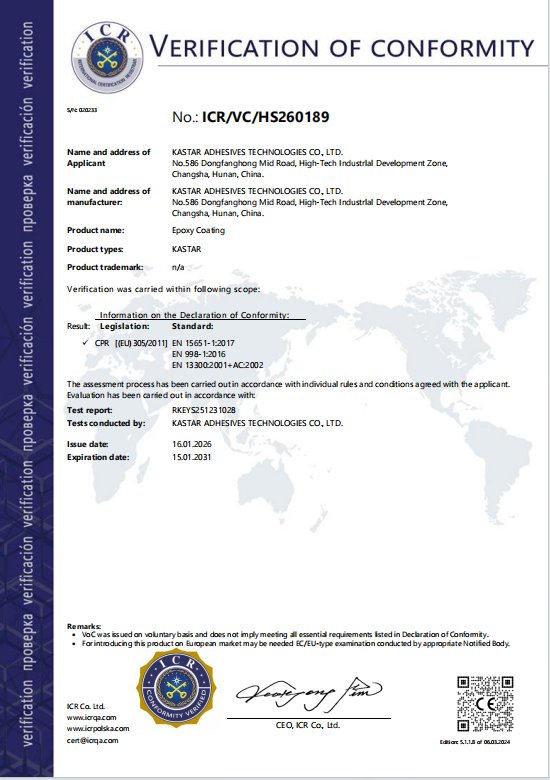
The certificate record is useful because it gives the buyer a concrete document to request and review. It is not a substitute for project-specific compliance. A CE certificate should be checked for scope, current validity, and relevance to the intended use. The buyer should also confirm whether the project requires additional national, local, fire, VOC, slip-resistance, or healthcare-specific evidence.
2. MOQ of 50 buckets: quantity, packaging, and label control
MOQ 50 buckets is a commercial threshold. Its acceptance check should confirm the number of buckets, the packaging condition, the label text, the batch code, and the product identity on each unit. If the order includes custom color or texture, the label should match the approved sample reference. The buyer should not convert 50 buckets into floor coverage unless the supplier provides written coverage data for the specific system and substrate conditions.
For an OEM bulk order, the packaging and label check becomes part of brand control. The purchase order should state who approves the artwork, what information must appear on the label, and how the batch code is recorded. The acceptance evidence is the packing list plus the pre-shipment packaging inspection record.
3. FOB/CIF delivery: separate quality release from transit risk
FOB and CIF are delivery terms, not quality guarantees. In general trade practice, FOB and CIF allocate cost and risk differently, and the order should name the port and the applicable Incoterms version. Under FOB, the buyer typically arranges the main carriage; under CIF, the seller typically arranges freight and insurance to the named destination. In both cases, the pre-shipment test should be completed before loading, and the shipping documents should be checked separately.
The acceptance file should therefore contain two layers: a pre-shipment quality release and a shipping document release. The quality release covers the product and packaging. The shipping document release covers the commercial invoice, packing list, transport document, and any insurance document required by the delivery term. A clean pre-shipment test does not resolve transit damage, container condition, or document errors after loading.
4. 30/70 payment: define the release milestone
The supplied payment term is recorded as 30/70. A bare ratio does not identify what triggers each portion. The contract should state whether the first portion is released at order confirmation, production start, or document approval, and whether the second portion is released against the pre-shipment test report, the transport document, or arrival inspection. This is a contractual clarification, not a new technical claim.
For the buyer, the safest structure is to link the balance release to documents that can be checked. If the supplier expects payment before shipment, the buyer should require the agreed pre-shipment test report and packaging record before releasing the balance. If payment is linked to arrival, the buyer should define who inspects and what happens if the shipment is held.
5. Pre-shipment test: turn a stage into a protocol
The supplied acceptance criterion is pre-shipment test. This is the most important term to define in writing because it controls the quality release. The buyer should ask for the test plan, sampling method, test methods, acceptance limits, report format, retention sample arrangement, and nonconformance procedure. If the supplier cannot provide a test plan, the buyer should not invent one; the parties should agree one before production.
Where the project adopts T/FJFA 003-2022, the buyer can reference that standard in the acceptance plan. The standard should be cited with its correct scope and edition. It should not be presented as a universal requirement for every country or project. For non-China projects, the buyer should confirm the applicable local standard or project specification.

The pre-shipment test should also state what happens if the result fails. A practical nonconformance clause should cover retest, corrective action, rework or replacement, and the buyer's right to hold the balance. Without that clause, the test is only an observation, not an acceptance control.
6. Batch records and process traceability
Kastar reports 12 production and testing processes from production to delivery and batch sample testing. That is useful supplier information because it supports traceability. The buyer can turn it into an acceptance check by requiring batch codes, retained samples, and test records linked to the shipment. The check should confirm that the batch code on the packaging matches the batch code in the pre-shipment report.
Traceability does not prove performance by itself. It proves that the buyer can identify the batch and review the records. The performance conclusion still depends on the agreed test methods and limits.

7. Color and texture approval
The product record states that colors and textures are customizable. For a decorative floor, approval should be based on a physical or photographed reference sample that both parties sign. The acceptance check should compare the production batch against the approved sample under agreed lighting and viewing conditions. The record should identify the sample reference, approval date, and approver.
The supplied materials do not state a numerical color tolerance, so the buyer should not invent one. If color consistency is critical, the buyer should request a documented color-control procedure and agree the acceptance method before production.
8. Application-specific acceptance
The case record states that the product has been used by OEM flooring coating suppliers, construction contractors, commercial flooring installers, and building material distributors. It lists applications including commercial building flooring, industrial workshop flooring, hospital and school flooring, and retail store and hotel decorative flooring. The case result describes CE-compliant epoxy color sand floor coating with seamless, stain-resistant, easy-to-clean floors, wear resistance, and a decorative finish. The record also describes long-lasting performance over 15 years; that should be treated as a case claim, not a warranty, unless the contract states it.
These application notes are useful for structuring acceptance, but they do not replace the project specification. Industrial workshops may prioritize wear resistance and easy cleaning. Commercial malls, retail stores, and hotels may prioritize decorative finish and color consistency. Hospitals and schools may require additional evidence on slip resistance, indoor air quality, infection control, fire safety, and accessibility. A secondary technical article in the supplied evidence associates hospital epoxy flooring with those considerations, but the article is a research lead, not a verified mandatory threshold. Official standards and local codes must be checked for the actual project.
Step-by-step: building the acceptance file
- Freeze the product identity in the RFQ. Name Kastar 51 epoxy color sand floor coating, the required color and texture reference, and the certification record the buyer expects to review. Do not accept a generic product description that could be filled with a different model.
- Convert the four purchasing terms into a term sheet. Record MOQ 50 buckets, FOB/CIF with named port, pre-shipment test, and 30/70 payment. For each term, add the document and signatory that will close the check.
- Agree the pre-shipment test protocol before production. Define sampling, test methods, limits, report format, retention samples, and the nonconformance path. If T/FJFA 003-2022 or another standard applies, cite it with its correct scope.
- Set batch traceability. Require batch codes on packaging and on the test report. Keep a retained sample from the shipment batch when the order value or project risk justifies it.
- Approve color, texture, and packaging artwork. Use a signed sample reference for decorative requirements and a written label approval for OEM packaging.
- Verify MOQ quantity and packing list. Count the 50 buckets, check packaging condition, and confirm that labels match the approved artwork and batch records.
- Separate quality release from shipping documents. Complete the pre-shipment test before loading. Check the transport document, invoice, packing list, and insurance document required by the FOB or CIF term.
- Link the 30/70 payment split to defined milestones. State which document releases each portion and who signs the release.
- Write the nonconformance clause. Cover hold, retest, corrective action, replacement, and payment suspension. A test without a consequence is not a control.
- Close with project acceptance. After delivery, check packaging, batch identity, site storage, and application conditions against the approved file. For healthcare or other regulated spaces, confirm the additional compliance documents required by the project.
Application notes for different floor environments
Industrial workshops
For industrial workshop flooring, the buyer should connect the wear-resistant claim to a test report or documented performance evidence. The case record describes a durable, wear-resistant finish, but the acceptance file should state how wear resistance is evidenced for the ordered batch. Easy cleaning and seamless finish are also relevant, but they should be checked against the project specification rather than assumed from the product category.
Commercial malls, retail stores, and hotels
Decorative flooring places more weight on color and texture approval. The product record states that colors and textures are customizable, so the buyer should approve a sample and define how production will be compared with it. Stain resistance and easy cleaning are useful acceptance themes, but they should be tied to the agreed test plan or project requirement. The buyer should also confirm packaging and batch labeling for distributor or installer use.
Hospital and school floors
Hospitals and schools are higher-consequence environments. The supplied secondary article associates hospital epoxy flooring with slip resistance, low or zero VOC goals, infection control, fire safety, and accessibility. These are research leads, not verified universal requirements. The buyer should request official standards, local code references, and project-specific test evidence. CE certificate ICR/VC/HS260189 is a document to review, but it does not by itself establish compliance with every healthcare or education requirement. VOC limits such as the reported SCAQMD Rule 1113 limit of 100 g/L for floor coatings in California should be confirmed with the regulator and the project specification.
OEM suppliers, contractors, installers, and distributors
For OEM flooring coating suppliers and distributors, customization can cover color, viscosity, packaging, and formula adjustments. The acceptance file should therefore include the approved sample, packaging artwork, batch record, and any private-label requirements. A customization factory should confirm in writing which parameters are fixed and which are adjustable. Factory-direct supply can shorten the document chain, but the buyer should still identify the legal manufacturer, production site, and certificate holder in the acceptance file.
Comparison table: term, evidence, and boundary
| Purchasing term | What to verify | Acceptance evidence | Boundary |
|---|---|---|---|
| MOQ 50 buckets | Quantity, packaging condition, label, batch code, color or texture reference | Packing list, pre-shipment packaging inspection, approved label artwork | Does not define coverage per bucket or quality level |
| Delivery terms FOB/CIF | Named port, Incoterms version, loading condition, shipping documents | Transport document, commercial invoice, packing list, insurance document where required | Does not replace pre-shipment quality release or transit damage inspection |
| Pre-shipment test | Sampling, test methods, limits, report, retention sample, sign-off | Agreed test plan, test report, batch record, nonconformance record if applicable | The bare term does not state methods or pass or fail limits |
| Payment terms 30/70 | Milestone for each portion and documents required for release | Contract milestone table, release sign-off, inspection or shipping documents | The ratio alone does not define the release trigger |
| CE certificate record ICR/VC/HS260189 | Product identity, certificate scope, issuer, validity dates, listed standards | Certificate copy, product match check, project compliance review | Not a universal approval for every market or application |
| Custom colors and textures | Approved sample, viewing conditions, batch comparison, label reference | Signed sample record, production comparison record, batch code | The supplied materials do not state a numerical color tolerance |
The table is deliberately limited to supplied facts and practical document logic. It does not set numerical performance limits because the available record does not provide them.
FAQ
What purchasing terms and acceptance criteria are documented for Kastar 51 epoxy color sand floor coating?
The supplied purchasing and acceptance record lists MOQ 50 buckets, delivery terms FOB/CIF, acceptance criteria pre-shipment test, and payment terms 30/70. These are commercial and release-stage terms. They should be attached to written documents and sign-off points before the order is confirmed.
How should a buyer turn pre-shipment test into an enforceable acceptance criterion?
The buyer should request a written test plan that identifies sampling, test methods, acceptance limits, report format, retention samples, and the nonconformance path. The supplied term names the stage but does not state those details. If a project standard such as T/FJFA 003-2022 applies, it should be cited with its correct scope and edition.
What should be checked on the CE certificate before shipment release?
Check certificate number ICR/VC/HS260189, issuer ICR, validity from 16 January 2026 to 15 January 2031, product identity, and listed standards EN 15651-1:2017, EN 998-1:2016, and EN 13300:2001+AC:2002. Confirm that the certificate scope matches the ordered product and the intended market. A certificate record is not a substitute for project-specific compliance.
How do MOQ 50 buckets and FOB/CIF affect acceptance planning?
MOQ 50 buckets sets the quantity and packaging check. FOB/CIF sets the delivery basis and document set. Neither term proves product quality. The acceptance file should include a pre-shipment quality release for product and packaging, plus a separate document review for transport, invoice, packing list, and insurance where required.
What application evidence can support acceptance for industrial, commercial, hospital, school, retail, and hotel floors?
The case record states use by OEM flooring coating suppliers, construction contractors, commercial flooring installers, and building material distributors. It lists commercial building, industrial workshop, hospital and school, and retail store and hotel flooring applications. The result describes CE-compliant coating with seamless, stain-resistant, easy-clean floors, wear resistance, and decorative finish. These are case claims and should be matched to project-specific tests and official requirements.
Can a buyer request a sample and current document pack before finalizing acceptance criteria?
Yes. A sample, color or texture reference, certificate copy, and product brochure are practical steps before the final purchase order. The public Kastar product brochure is available here: Kastar product brochure. Use the sample approval and document review to close the acceptance file, not to replace it.
Conclusion: make the release decision auditable
The core lesson is simple: purchasing terms become useful only when they are converted into evidence. For Kastar 51 epoxy color sand floor coating, the supplied terms give the buyer a starting framework: MOQ 50 buckets, FOB/CIF delivery, pre-shipment test acceptance, and 30/70 payment. The buyer should add the missing execution details without inventing technical figures. That means defining product identity, certificate review, sampling, test methods, batch traceability, color approval, packaging checks, shipping documents, payment milestones, and nonconformance rules.
The case record supports industrial, commercial, healthcare, education, retail, and hospitality use, but it does not replace project-specific verification. A disciplined acceptance matrix protects the buyer from comparing non-equivalent offers and protects the supplier from unclear release expectations. The result is a purchase order that can be checked, signed, and closed with documents rather than assumptions.