- FAQ
- 443
Silicone Waterproof Coating Failures: How to Diagnose and Fix Common Application Problems
Diagnose and fix silicone waterproof coating failures: adhesion loss, bubbling, cracking and uneven curing, plus how Kastar process control and site support reduce them.
Silicone Waterproof Coating Failures: How to Diagnose and Fix Common Application Problems

Most silicone waterproof coating failures are not polymer failures. They are substrate, moisture, temperature, mixing or film-thickness problems that were built into the job before the first coat went on. A lifted edge, a blister, a crack and a tacky patch look different on the surface, but they are diagnosed the same way: find where the coating separated, verify what was underneath it, check the conditions at the time of application, and only then question the material batch.
This guide covers the four failures behind most field complaints on silicone waterproof coating work — adhesion failure, bubbling, cracking and inconsistent curing — with root causes and a corrective sequence for each. It then explains which of those failures can be prevented before the material leaves the factory, and what an execution-stage buyer should expect from a supplier when a problem appears on site.
What Counts as a Failure, and Where to Start
A failure is any condition where the cured coating no longer performs the function it was specified for: it has detached from the substrate, blistered away from it, cracked through the film, or never cured into a continuous, uniform membrane. Cosmetic variation in colour or sheen is not, by itself, a failure.
Performance benchmarks help separate a material problem from a workmanship problem. ASTM D6694/D6694M-25 sets a minimum tensile strength of 150 psi and a minimum elongation of 100% for liquid-applied silicone roof coatings (ASTM International). If a cured sample taken from the site tears instead of stretching, either the film is not what was specified or it was not applied and cured as specified — and that difference determines who pays for the repair.
Start at the interface. Coating that peels cleanly from the substrate with a chalky or dusty residue on its underside points to surface preparation or contamination. Coating that separates from itself points to a recoat-interval or inter-coat contamination problem. Blisters that grow over weeks point to moisture; bubbles that appear within hours of application point to trapped air or solvent. One diagnosis session at the right interface usually replaces several speculative repairs.
Five Checks That Explain Most Silicone Waterproof Coating Failures
Before repair work begins, run the same five checks across every affected area. They cost far less than a single unnecessary re-coat.
- Substrate moisture. Moisture held in concrete, screed or an old coating turns to vapour under solar heating and pushes the new film off from below. Measure with a moisture meter and compare the reading with the coating manufacturer's stated limit for the substrate.
- Surface condition and contamination. Dust, curing compounds, release agents, oils, chalking and loose friable material all reduce bond. A rub test and a water-bead observation quickly show whether a surface is sound and absorbent or sealed and contaminated.
- Temperature and humidity at application. Applying outside the manufacturer's window can skin the surface before the coating has bonded. High surface temperature also speeds solvent release and can generate pinholes and bubbles.
- Mixing and induction. Pigmented and multi-pack products need thorough mechanical mixing for the stated time. Incomplete mixing produces tacky patches, colour variation and soft spots that look exactly like a curing failure.
- Film thickness and recoat interval. Kastar publishes reference parameters for its elastic waterproof coating of approximately 1 kg per square metre per coat, two coats, 0.8–1 mm total film thickness and a 4–12 hour interval between coats depending on weather. One heavy coat outside that interval traps air and solvent; a film thinner than specification loses the elongation the system was chosen for.
Adhesion Failure: Peeling, Delamination and Loss of Bond
Adhesion failure appears as coating that lifts at edges, peels in sheets, or can be scraped off with little resistance. The causes cluster into three groups: a contaminated or friable substrate, moisture inside the substrate, and an incompatible or under-prepared existing coating. Applying outside the temperature window, or applying too thin a first coat on a porous surface, produces the same visible result.
- Map the extent. Probe adhesion across the area and mark a perimeter beyond the visible failure; accept only firmly bonded edges.
- Identify the interface. Establish whether the coating separated from the substrate or from a previous coat. This single observation decides whether the repair is surface preparation or inter-coat preparation.
- Remove all unsound material. Cut back to sound, bonded coating. Feathering over loose edges simply relocates the failure.
- Clean and prepare. Remove chalk, dust, oil and loose material using the coating manufacturer's recommended preparation method for that substrate.
- Dry the substrate. Confirm moisture is within the manufacturer's limit before any primer or coating is applied.
- Prime or scratch-coat porous and chalky substrates, and confirm compatibility with any remaining existing coating.
- Re-coat in the specified number of coats and thickness, inside the stated recoat interval.
- Verify before sign-off. Re-test adhesion and record the batch, ambient conditions and date against the repair area.
Bubbling and Blistering: Trapped Moisture, Air or Solvent
Bubbling is a film that has lifted locally into a dome, often with a hollow feel when pressed. Blistering that develops and grows over days or weeks usually indicates moisture vapour migrating from the substrate. Bubbles that appear within hours of application usually indicate air displaced from a porous substrate, solvent retained by an over-thick coat, or a recoat interval that was too short. Applying on a hot surface increases both risks.
- Cut a representative blister open and inspect the underside and the substrate. Free moisture, a damp substrate and a contamination film each require a different repair.
- If moisture is present, stop the water source first. Re-coating a wet substrate reproduces the failure, usually within one season.
- Remove all blistered and unbonded film, then clean the exposed area.
- Fill pinholes and porous zones, and apply a scratch coat where the substrate is open or absorbent.
- Rebuild with thinner coats rather than one heavy coat, respecting the recoat interval at every stage.
- Avoid direct high heat and conditions outside the product's stated window, then inspect the repaired area after the first thermal cycle.
Cracking, Splitting and Alligatoring
Cracking is the failure most often blamed on the product and most often caused by the system. Regular hairline cracking usually follows a film that is too thin, or one applied over a substrate that was not stable. Wide cracks that follow joints and changes of plane are movement cracks. Random map cracking can follow a coat applied well above the specified thickness, because the surface skins before the body of the film has cured.
Elasticity is the property that resists movement-induced cracking. Kastar's comparison data for silicone versus acrylic and polyurethane waterproof coatings state +200% elongation at break for silicone and zero bubbling under a 1,000-hour UV test. High elongation helps a coating bridge normal movement, but it does not compensate for an unreinforced joint or for a film applied at the wrong thickness.
- Classify the crack: hairline stress cracking, map cracking, or structural movement.
- Treat structural cracks and joints first — route, fill and reinforce with the sealant and reinforcement specified for the system.
- Remove cracked film in the repair area back to sound coating.
- Rebuild in coats to the specified total thickness rather than filling the crack in one pass.
- Check the thickness of the surrounding sound film. If it is under specification, the repair area is usually larger than the visible crack.
- Re-inspect after the first significant temperature cycle, when movement closes and opens the repaired detail.
Inconsistent Curing: Tacky Patches, Slow Set and Uneven Finish
Inconsistent curing looks like a coating that is hard in one area and soft, tacky or easily marked in another. The usual causes are incomplete mixing, application below the stated minimum temperature, condensation on a cold surface, a film applied too thick, or material that was stored badly or used beyond its shelf life.
- Record the batch and mixing details for the affected area before anything is removed. Without that record, the same cause repeats on the next delivery.
- Check material and substrate temperature and confirm the product's stated application window.
- Remove uncured or tacky material. Do not overcoat a film that has not cured; the soft layer remains a weak plane inside the finished system.
- Verify shelf life and storage history. Heat, freezing and opened containers can degrade some products before the printed expiry date.
- Re-apply in thin, uniform coats and preserve the recoat interval.
- Apply a mock-up panel first where site conditions are marginal, and confirm cure before full application.
Symptom-to-Cause Diagnostic Table
| Symptom | Most likely cause | Field check | Corrective action |
|---|---|---|---|
| Coating lifts in sheets; chalky residue on the underside | Contamination, chalking or moisture in the substrate | Adhesion probe, moisture meter, rub test | Remove unsound film, prepare and dry the substrate, prime, re-coat |
| Bubbles within hours of application | Air displaced from a porous substrate, or solvent trapped by a heavy coat | Cut a bubble; measure thickness and check recoat interval | Fill and prime pores; rebuild with thinner coats |
| Blisters that grow over weeks | Moisture vapour driving out of the substrate | Inspect underside for free moisture; trace the water source | Stop the water source, dry the substrate, re-coat |
| Regular hairline or map cracking | Film under or over specified thickness; unreinforced movement | Measure film thickness; inspect joints and changes of plane | Reinforce joints; rebuild the film to specified thickness |
| Soft or tacky patches | Incomplete mixing, low temperature, expired or badly stored material | Batch record, temperature log, mixing record | Remove uncured film, verify the material, re-apply in thin coats |
How Those Defects Are Prevented Before the Material Reaches Site
Four of the failures above belong to the applicator. Two of them — inconsistent curing and early adhesion loss — can also be started upstream, by a batch that was mixed inconsistently, stored badly, or damaged in transit. That is the part of failure control a buyer can specify at the order stage.

Kastar Adhesives Technologies Co., Ltd is an OEM/ODM manufacturer of coatings, paints, sealants and adhesives with a reported 150,000 m² factory. Production control is built around a 12-step full-process inspection and real-time in-line quality monitoring rather than end-of-line checking, supported by batch sampling, third-party testing and traceability management that links a delivered batch back to its production record. The company operates a 1,000 m² CMA-certified sealing material testing laboratory with 16 testing personnel and more than 100 testing instruments, and reports three national R&D laboratories.
Consistency starts with raw materials: Kastar sources raw materials globally and reports a monthly production capacity of 30,000 tons. Storage is humidity-controlled and palletized, using sealed moisture-proof containers with an inventory rotation system and regular storage condition inspections — controls that matter because a coating that has taken up moisture in storage cures unevenly on site. Packaging is inspected before shipment, and transport protection includes customized palletized packaging, reinforced corrugated cartons with foam inserts, full cargo insurance and real-time logistics tracking.
Kastar is a participant in the drafting of Chinese standards for silicone waterproof coatings and a drafting unit for five Chinese group standards, and holds an invention patent for a silicone waterproof coating device and process. The company reports ISO 9001 certification, states that its products have passed ISO 9001, CE and SGS certification, and uses REACH-compliant raw materials. Certificate and report scope for a specific product and destination market should be confirmed at the quotation stage rather than assumed from a general list.
On-Site Support: What Execution-Stage Buyers Should Ask For
Technical support changes a failure rate only when it is available before and during application, not after a complaint. Kastar provides one-on-one construction guidance from professional engineers, one-on-one after-sales service, and on-site technical support for large projects.

For a distributor or contractor preparing a project, the practical request list is:
- Written application parameters for the exact product: coverage per coat, number of coats, total film thickness, recoat interval, and the acceptable temperature and humidity window.
- The batch test report and product data sheet for the delivered batch, not only a general brochure.
- Storage instructions and a shelf-life statement matched to the packaging actually supplied.
- A named technical contact for the project, and a defined scope for on-site support on large projects.
- OEM/ODM scope where the project is private label: colour, viscosity, packaging and formula adjustment. Kastar offers all four as customization options.
Purchasing terms that affect execution: MOQ is 50 buckets, delivery terms are FOB or CIF, pre-shipment test is the stated acceptance criterion, and payment terms are 30/70. These terms belong in the same document as the technical parameters, because a repair dispute is usually decided by what was agreed before delivery.
Matching the Repair to Roof and Exterior Wall Work
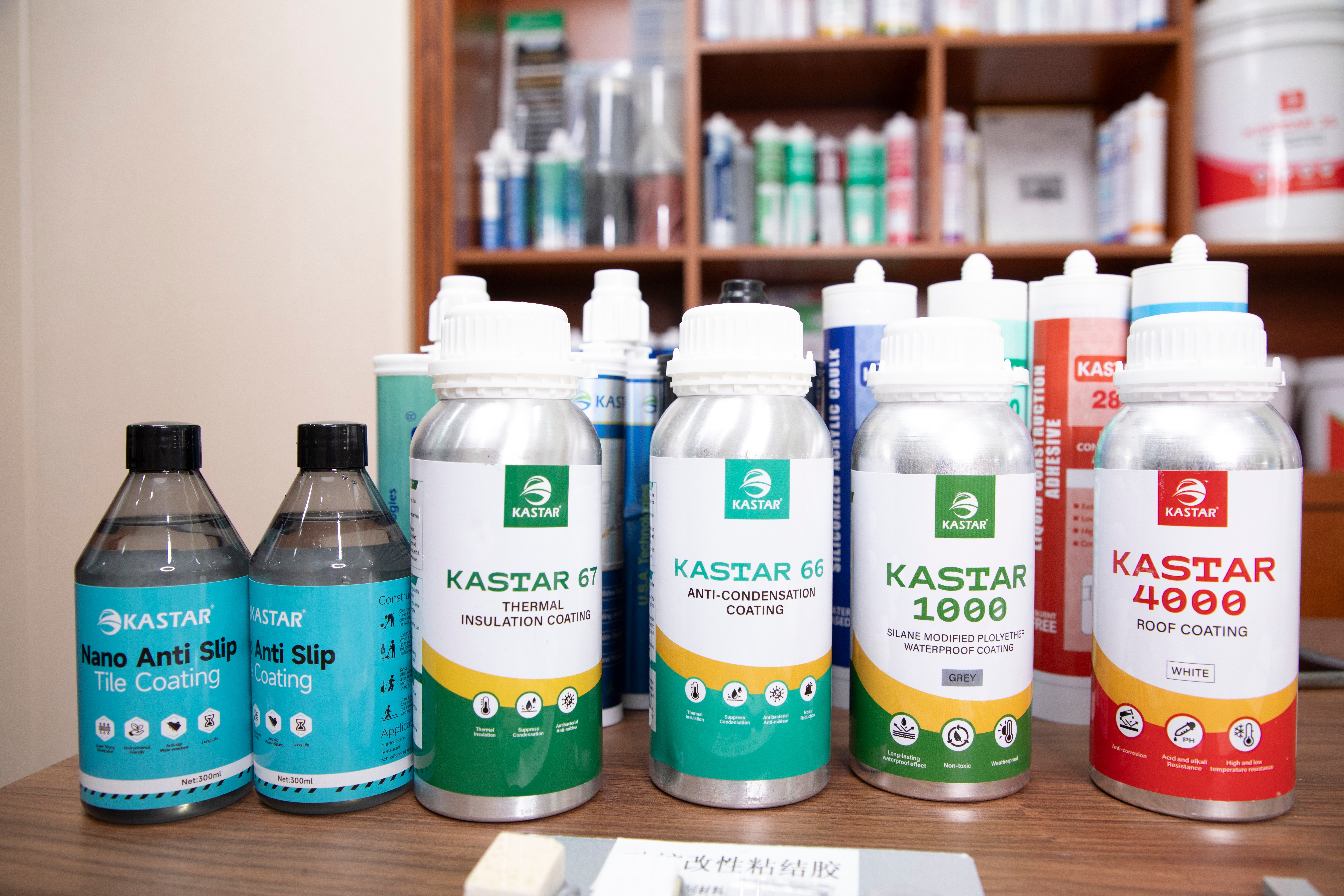
Roof work concentrates the moisture-vapour and surface-temperature risks: an exposed roof reaches high surface temperatures, so blistering and pinhole formation are most likely there. Kastar markets KASTAR 4000 Silicone Elastic Roof Waterproof Coating for exposed building roofs, and lists KASTAR 3000 Silicone Elastic Exterior Wall Waterproof Coating in its product range. On walls the common risks shift to thin films over large areas and movement at joints, so thickness control and joint reinforcement matter more than heat resistance. For below-grade and basement work, confirm the system's suitability and application parameters with the manufacturer before specifying; hydrostatic conditions are not the same as roof exposure.
FAQ
Does a silicone waterproof coating have to meet a performance standard?
For liquid-applied silicone roof coatings, ASTM D6694/D6694M-25 sets a minimum tensile strength of 150 psi and a minimum elongation of 100% (ASTM International). That gives a specifier a baseline for the cured film, and project specifications can add adhesion, UV ageing or water-impermeability requirements. Ask the supplier for product-specific test reports against the standard named in your specification rather than a general certificate list. Kastar reports ISO 9001 certification and states that its products have passed ISO 9001, CE and SGS certification; because certificate scope and product coverage vary, request the certificate and report for the exact product and market you are buying for.
Can a batch or storage problem look like an application failure?
Yes. Tacky patches, uneven cure and early adhesion loss can come from material that was stored badly, mixed incompletely or used past its shelf life, and the surface symptom looks the same as an application error. Kastar controls this with a 12-step full-process inspection, real-time in-line quality monitoring, batch sampling and third-party testing, traceability management, and a 1,000 m² CMA-certified testing laboratory with 16 testing personnel and more than 100 instruments. Storage is humidity-controlled, palletized and sealed, with an inventory rotation system and regular storage condition inspections.
Is a higher material cost justified if it prevents failures?
Repair cost is driven by access, removal, surface re-preparation, re-coating and schedule disruption, not by the coating alone. Kastar's comparison data for silicone versus acrylic and polyurethane waterproof coatings state a 5%–15% higher material cost and a 70% lower long-term maintenance cost, with maintenance-free performance for 10+ years and a stated warranty of more than 25 years. Treat these as the manufacturer's comparison figures and verify them against your own project conditions, exposure and specification.
How can a buyer validate a coating before a bulk order?
Request the technical data sheet and safety data sheet for the exact product, a batch test report, and the application parameters in writing: coverage per coat, number of coats, total film thickness and recoat interval. Then apply a mock-up panel on the same substrate under site conditions and check adhesion and cure before releasing the order. Kastar's stated acceptance criterion is a pre-shipment test, batch sample testing is part of its 12-step process, and its laboratory carries out the testing; MOQ is 50 buckets, delivery terms are FOB or CIF, and payment terms are 30/70.
What supports supply continuity and long-term distributor programs?
Monthly production capacity is 30,000 tons, supported by global raw material sourcing, 12 production and testing processes, humidity-controlled storage with inventory rotation, and packaging checks before shipment, including customized palletized packaging, reinforced cartons with foam inserts, full cargo insurance and real-time logistics tracking. Kastar also provides OEM/ODM customization of colour, viscosity, packaging and formula, one-on-one construction guidance from professional engineers, one-on-one after-sales service, and on-site technical support for large projects. For project-specific guidance, contact Nicole at paint4566@kastarpaint.com or +86 15974221507 (WhatsApp available). The product brochure can be downloaded here: Kastar product brochure (PDF).
Conclusion
Most silicone waterproof coating failures are decided before the first coat: substrate moisture, surface condition, temperature at application, mixing discipline and film thickness. Diagnose at the interface, verify the conditions, and repair the cause rather than the symptom — because re-coating over an undiagnosed failure is the most expensive way to repeat it. Where material consistency, storage history or transport damage is a plausible contributor, the correct response is documentation and batch traceability, not a thicker repair coat.