
- FAQ
- 442
Silicone Waterproof Coating OEM Terms & Acceptance FAQ
Distributor FAQ on silicone waterproof coating purchasing terms and acceptance criteria: batch testing, CMA lab, packaging, rotation, delivery and OEM support.
Silicone Waterproof Coating Purchasing Terms and Acceptance Criteria: An OEM Partnership FAQ
Direct answer: In an OEM or ODM silicone waterproof coating programme, purchasing terms decide who carries the commercial risk and acceptance criteria decide what counts as conforming product when a batch arrives. Distributors run into trouble when they negotiate the first and leave the second unwritten. Kastar Adhesives Technologies Co., Ltd. addresses the second half of that problem with documented process controls, including 12 production and testing processes, batch sample testing, a 1000㎡ CMA-certified sealing material testing laboratory and one-to-one engineering support. Price, MOQ, payment and exclusivity are not settled here; they belong in a written quotation.
This reference is written for importers, distributors and private-label brand owners who already know roughly what they want to buy and now need to buy it repeatably. Each section answers a question that tends to appear in the same order during supplier onboarding.
- Why terms and criteria fail when they are negotiated separately
- What the four layers of an enforceable acceptance criterion look like
- How batch testing, the CMA-certified laboratory and packaging controls work
- How to convert delivery, rotation and technical support from promises into clauses
- Seven questions distributors ask most often, answered directly
Why purchasing terms and acceptance criteria must be negotiated together
Purchasing terms allocate commercial risk; acceptance criteria allocate technical risk. A distributor that signs a price and a quantity but no measurable acceptance criteria has, in practice, agreed to accept whatever arrives. The reverse failure is just as common: a technically excellent specification with no claims window, no sampling rule and no document list cannot be enforced, because there is no defined moment at which a defect becomes the supplier's responsibility.
In silicone waterproof coating work, the gap usually surfaces in three places: a batch whose solids or viscosity drifts away from the approved sample, packaging that fails in transit or after months in a warehouse, and a label claim that the supplier's documentation does not actually cover. Each of these is far cheaper to prevent with a clause than to resolve after the container has cleared customs and the product is already on a customer's roof.
What is changing in silicone waterproof coating supply
Two external developments shape how terms are written in 2026. The first is scale. Market.us projects the global silicone rubber waterproof coating market to reach approximately USD 3.5 billion by 2034, with Asia-Pacific holding a 45.9% revenue share in 2024 (Market.us, source dated 15 November 2025). A larger and more concentrated supply base gives buyers more factories to compare, and more reason to compare them on documents rather than on a single sent sample.
The second is standards. ASTM D6694/D6694M-25 sets minimum tensile strength of 150 psi and minimum elongation of 100% for liquid-applied silicone roof coatings. It is a US-oriented benchmark for one product category, not a global requirement, and it does not approve any supplier by itself. Its practical value is neutral: it gives both parties a named reference point for a test method, which is precisely what an acceptance criterion needs.
Certification language has loosened at the same time. A phrase such as 'ISO 9001, CE and SGS certified' mixes three different things: a management system standard, a European conformity-marking framework, and a testing organisation. A phrase is not a scope. Buyers who ask for the certificate number, the product scope and the validity date separate suppliers who can produce documents from suppliers who can only produce adjectives.
The four layers of an acceptance criterion
A criterion that survives a commercial dispute has four layers. Missing any one of them leaves a gap that the cheapest available interpretation will fill.
Layer 1: identity and formulation
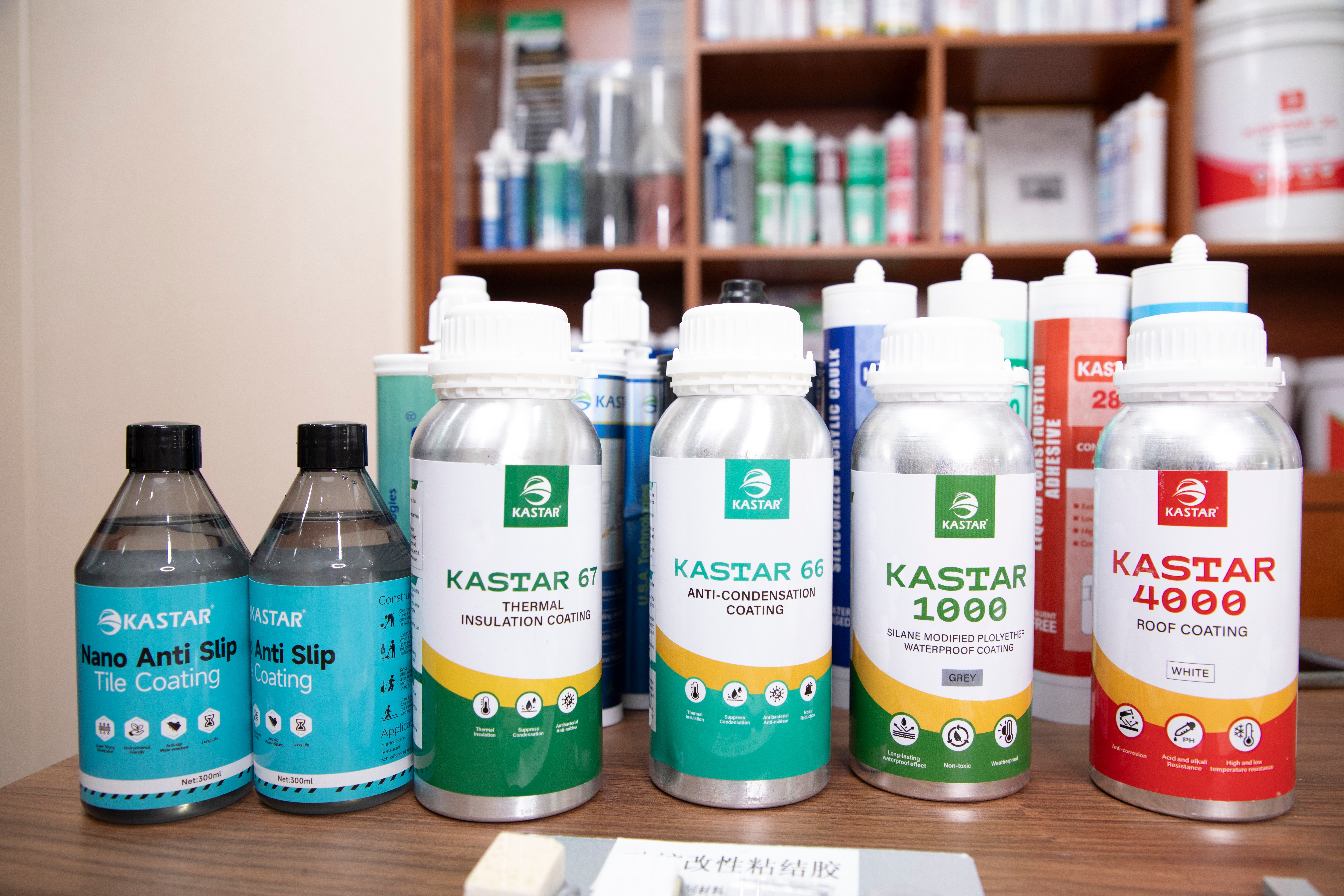
The first layer fixes what the product is: product category, reference code, colour, and any agreed departure from the standard formula. In the supplied material, Kastar's silicone waterproof coating line is represented by a one-component, UV-resistant coating in which silicone is the primary material, listed as Kastar 4000 Silicone Waterproof Coating. Where a distributor orders a customised version, the agreement should state which parameters may change and which are locked, so that 'customized' does not quietly become a different product between the sample and the production run.
Layer 2: measured performance
The second layer converts adjectives into numbers with a method attached. Kastar 4000's published parameters list solid content of 98%, elongation at break of ≥200%, tensile strength of ≥1.2 MPa, UV resistance of 1000 h with no cracking or peeling, an operating temperature range of -80°C to 180°C and an outdoor service life of ≥25 years. These are manufacturer-published parameters rather than third-party certification, and the test methods behind them should be requested before any of them is written into a contract as a pass/fail limit. Note also that comparing them with ASTM D6694 requires a single unit: 1 MPa equals 145.04 psi.
Layer 3: batch consistency
The third layer defines how much variation is acceptable between batches and how that variation is checked. Sampling frequency, retained-sample period, permitted tolerance on the agreed parameters and the consequence of a failed result all belong here. A specification with no sampling rule effectively applies only to the sample, not to the order.
Layer 4: documentation
The fourth layer lists the paper that must accompany each shipment: certificate of analysis, batch code, technical data sheet, safety data sheet, certificate copies with scope and validity, and a packing list that maps cartons and pallets back to batch codes. Documentation is what makes the first three layers auditable six months later.
What Kastar's 12 production and testing processes mean for a batch
Kastar describes 12 production and testing processes between production and delivery, supported by batch sample testing to track quality across the whole sequence. For a buyer, the count matters less than the structure it implies. Inspection distributed across a run can catch drift before the whole batch is packaged; a single end-of-line check can only reject a finished lot.

Production and inspection points are distributed across the run rather than concentrated at final packing.
The useful questions in a supplier discussion are therefore not 'how many steps' but 'which of those points generate a retrievable record'. Ask who signs each record, whether the record can be pulled by batch code after delivery, what happens to a non-conforming lot before packing, and whether a retained sample from each batch is kept for the period stated in the agreement. A supplier who can answer these has a process; a supplier who cannot has a diagram.
Batch testing, the CMA-certified laboratory and what to request in writing
Kastar operates a 1000㎡ China Metrology Accreditation (CMA) certified sealing material testing laboratory with 16 testing personnel and more than 100 testing instruments and equipment. CMA is a Chinese accreditation scheme for testing laboratories. It supports the credibility of in-house test data and the consistency of the methods used, but it does not replace the destination market's conformity assessment, and it should not be presented to customers as if it did.
Retained batch samples allow a disputed delivery to be re-tested against the approved reference.
The practical output of a laboratory is not a certificate on a wall; it is a document per batch. Distributors should request a certificate of analysis that mirrors the agreed acceptance criteria line by line, with the test method named next to each value, the batch code printed on the document, and a retained sample identified for the agreed retention period. Where the destination market applies a recognised benchmark such as ASTM D6694 for roof coatings, the agreement can reference that benchmark alongside the supplier's own published values, and state explicitly which one governs in a dispute. That single sentence prevents most arguments.
Packaging, storage and stock rotation: where shelf life is lost
Packaging is the part of the specification that most often fails after acceptance, and the easiest to write down. Kastar uses fully automated packaging equipment developed and produced independently, described as delivering 100% brand new packaging with strong sealing and long shelf life. The acceptance wording should capture the container type, fill weight and tolerance, closure specification, labelling content and a simple seal or leak check at receiving.
Storage discipline is the second half. Kastar's factories are ISO 9001 certified, which provides the management-system frame for documented handling and storage procedures. For a distributor, the enforceable items are batch date coding on unit, carton and pallet; a first-in-first-out dispatch rule; agreed stacking and storage conditions in the distributor's own warehouse; and a shelf-life statement that matches what the packaging can actually deliver.
Stock rotation deserves explicit attention because it is invisible until it fails. Ask the supplier to confirm in writing how batch age is marked, how older stock is prioritised at dispatch, and what the maximum batch age is at the point of shipment. Where those figures are not published in advance, they should be negotiated for the specific programme rather than assumed from a sample container.
Delivery reliability: the terms that prevent a lost season
Delivery reliability is a clause, not an expectation. Kastar reports a 150,000㎡ manufacturing facility, more than 200 staff and annual production capacity of approximately 300,000 tons, with export business accounting for 100% of sales, products shipped to 69 countries and regions and over 1,000 customers served. Main markets include the United States, Canada, Australia and New Zealand.
Read that capacity figure in context: it covers coatings, paints, sealants and adhesives across the company, not the silicone waterproof coating line alone. It is useful evidence of industrial scale and continuity, not a delivery commitment for a specific order. The delivery commitment belongs in the quotation and the agreement, expressed as production lead time, documentation lead time, shipment window and the remedy if a window is missed. Construction seasons do not move, so a two-week slippage in a roof-coating programme can cost more than the price difference between two suppliers.
After-sales technical support across a multi-year partnership
Kastar provides one-to-one engineering construction guidance, one-to-one after-sales service and on-site technical support for large projects. For a distributor, that is the difference between reselling a product and owning an application outcome, particularly when a contractor applies the coating to an unfamiliar substrate or in unusual weather.

Named engineering and after-sales contacts convert support from a promise into a process.
Support becomes contractual when four things are agreed: who the named technical contact is, what triggers escalation to on-site support, what language and time zone the support operates in, and how application questions are logged so that repeated field problems reach the formula team rather than being answered individually forever. A distributor that documents field issues is also building the evidence base for the next formula iteration, which is where an ODM relationship earns its keep.
Acceptance criteria at a glance
The table below maps the criteria discussed above to the wording and evidence a distributor should hold before releasing a purchase order. It contains only parameters and certifications supported by the supplied material.
| Acceptance point | Write in the agreement | Document to request | Published basis |
|---|---|---|---|
| Tensile strength and elongation | Unit, minimum value, named test method, sampling frequency | Batch test report with method reference | Kastar 4000: tensile ≥1.2 MPa, elongation ≥200%. ASTM D6694/D6694M-25: 150 psi / 100% minimum for liquid-applied silicone roof coatings. Compare in one unit (1 MPa = 145.04 psi). |
| Solids content | Minimum percentage and test method | Certificate of analysis per batch | Kastar 4000 published solid content: 98%. |
| UV and weathering | Ageing hours and pass criteria | Ageing or weathering report | Kastar 4000 published value: 1000 h no cracking or peeling; test method to be confirmed. |
| Packaging integrity | Container type, fill weight tolerance, seal check | Packaging specification sheet | Fully automated packaging equipment developed and produced independently; 100% brand new packaging, strong sealing, long shelf life. |
| Batch traceability | Batch code on unit, carton and pallet; retained-sample period | Batch record extract and retained sample | 12 production and testing processes from production to delivery, with batch sample testing. |
| Certification scope | Exact standard, certificate number, covered product, validity | Certificate copies and applicable test reports | ISO 9001 certification for factories; SGS, REACH and ISO 9001 stated for products, with CE also listed in the company profile. Numbers, issuing bodies and product scope to be supplied. |
A first OEM order, step by step
- Define the product in one page. Reference product, colour, packaging and the parameters that must not change. Anything not on that page is not protected.
- Agree the acceptance criteria. Test method plus value plus sampling rule for each parameter, with the governing standard named where one applies.
- Request documents before samples. Certificate copies with scope and validity, technical and safety data sheets, and a sample of the actual certificate of analysis format.
- Test the sample against your own criteria. Record the method and the result. The approved sample becomes the reference, retained by both parties.
- Fix packaging, marking and rotation rules. Fill weight tolerance, seal check, batch coding, maximum batch age at shipment and first-in-first-out dispatch.
- Put delivery, support and remedy in the agreement. Lead time, shipment window, named technical contact, escalation trigger and the consequence of a failed batch.
- Review the first commercial batch as a project. Compare its certificate of analysis with the approved sample, log any deviation, and update the criteria before scaling volume.
Where these controls matter most: roof, wall and below-grade projects
Application decides which criteria carry the most weight. On exposed roofs, UV and weather resistance lead, which is why Kastar positions its silicone elastic roof coating for exposed building roofs and publishes UV ageing values for the product line. On exterior walls, adhesion to the substrate and colour stability for customised shades matter more, because a distributor is usually selling a finish as well as a barrier. Expansion joints and wet areas such as bathrooms shift the emphasis to elongation and crack-bridging, since movement rather than sunlight drives failure.
Below-grade and basement work is a separate qualification question. The supplied application material for this product line centres on roofs, exterior walls, expansion joints and wet areas, so a distributor planning to position the product for below-grade use should confirm that application in writing before printing it on a label. Application data indicates the coating is suited to construction-sector waterproofing and roofing work and is commonly used in markets including the United States, Canada, Australia, the Netherlands and Thailand, but market familiarity is not the same as a suitability statement for a specific structure.
FAQ: purchasing terms and acceptance questions from distributors
What purchasing terms should a distributor confirm before the first OEM order?
Confirm eight items in writing: product specification and reference test methods, order quantity and price basis, packaging specification, delivery term, batch documentation, certificate scope, claims window and artwork ownership. These eight determine whether a shipment can be accepted or rejected. Payment schedule, exclusivity and annual volume commitments are negotiable, but they sit on top of these. Kastar's public material describes OEM and ODM capability, including custom colour, viscosity, packaging and formula adjustment, but it does not publish price, MOQ or payment terms. Those arrive with a written quotation, and the quotation should be treated as the commercial baseline to which the acceptance criteria attach.
What acceptance criteria should be written into a silicone waterproof coating agreement?
Write each criterion as test method plus value plus sampling rule, never as a single adjective such as high quality. A line reading tensile strength of at least 1.2 MPa, tested to a named method on one retained sample per batch, is enforceable; a line reading good elasticity is not. Where a recognised benchmark applies, name it alongside the supplier's published values and state which governs in a dispute. Keep units consistent: ASTM D6694/D6694M-25 sets 150 psi and 100% elongation for liquid-applied silicone roof coatings, while Kastar 4000 lists 1.2 MPa and 200%, so convert before comparing.
How is batch testing handled, and what documents should accompany each batch?
Kastar runs 12 production and testing processes between production and delivery with batch sample testing, and tests in a 1000㎡ CMA-certified sealing material testing laboratory staffed by 16 testing personnel with over 100 instruments. What a distributor should hold per batch is narrower than that: a certificate of analysis mirroring the agreed criteria, the batch code printed on packaging and paperwork, and a retained sample kept for the agreed period. CMA accreditation supports the credibility of in-house data but does not replace destination-market conformity assessment, so export programmes should pair it with the market's own requirements.
Can colour, viscosity, packaging or the formula itself be customised?
Kastar offers OEM and ODM services that include customisation of colour, viscosity, packaging and formula adjustment. The commercial question is not whether a change is possible but who owns it afterwards. Before approving a custom formula, agree in writing which parameters are locked, what tolerance applies to each, whether the modified formulation can be supplied to another buyer, and which party holds the technical documentation. Customisation without that clause turns a differentiated product into a shared one.
How should a distributor verify delivery reliability and stock rotation?
Verify delivery through written commitments and rotation through marking rules, not through assurances. Kastar reports a 150,000㎡ facility, over 200 staff, annual capacity of approximately 300,000 tons and exports to 69 countries and regions serving over 1,000 customers; that capacity spans coatings, paints, sealants and adhesives, so it is context rather than an order-specific lead time. Ask for a production and documentation lead time per order, a maximum batch age at shipment, and confirmation that dispatch follows first-in-first-out. Kastar's factories are ISO 9001 certified, which provides the documented-procedure frame those rules need.
What long-term technical support is available after the first container?
Kastar provides one-to-one engineering construction guidance, one-to-one after-sales service and on-site technical support for large projects. Long-term value comes from how that is operationalised: a named technical contact for the account, a defined escalation path from email to on-site attendance, agreed working language and time zone, and a simple log of field questions that feeds back into formulation review. Distributors who run that log find that application problems decline over successive seasons, which is one of the few advantages a private-label programme has over spot purchasing.
How do I request samples, certificates or a quotation?
Samples, certificate copies and quotations are handled per project through the Kastar sales and technical team. Prepare three things first: the application and substrate, the annual volume you realistically expect, and the parameters you intend to test. With those, the sample can be paired with the right product reference and the quotation can be structured against the acceptance criteria rather than against a generic price list. The company can be reached at paint4566@kastarpaint.com or +86 15974221507.
Conclusion: write the criteria before you compare the price
Silicone waterproof coating is a simple product to buy once and a difficult one to buy repeatedly without documents. The distributors who avoid trouble are not the ones who negotiate hardest on unit price; they are the ones who arrive at the first quotation with a one-page specification, a named test method for every number, a document list per batch and a rotation rule for the warehouse.
Kastar's contribution to that structure is procedural rather than rhetorical: 12 production and testing processes with batch sample testing, a 1000㎡ CMA-certified sealing material testing laboratory with 16 testing personnel and over 100 instruments, ISO 9001 certified factories, independent packaging equipment, and one-to-one engineering and after-sales support. Together with 28 years of production experience since 1997 and export activity across 69 countries and regions, these are the elements a distributor can ask to see, rather than the elements a distributor has to believe.

Request a sample matched to your application, then test it against the criteria you intend to contract.
To start, send your application and expected volume, and request a sample together with the certificate of analysis format used for batch release. The Kastar product brochure (PDF) covers the wider coatings, paint, sealant and adhesive range, including the epoxy colour sand floor coating and MS sealant lines, for distributors assembling a full catalogue rather than a single SKU.