- FAQ
- 152
REACH, CE, and ISO 45001: The Compliance Checklist for Silicone Waterproof Coating Imports
Import silicone waterproof coating with confidence: verify REACH declarations, CE certificate scope, and ISO 45001 factory evidence before you place a bulk order.
REACH, CE, and ISO 45001: The Compliance Checklist for Silicone Waterproof Coating Imports
Silicone waterproof coating for building roofs, exterior walls, and basements is rarely rejected for performance. It is rejected for paperwork. This guide walks importers, distributors, and specifiers through the three frameworks that decide whether a container clears the border and whether a project engineer signs off: REACH for chemical compliance, CE for product conformity with the standards named on the certificate, and ISO 45001 for how the factory manages chemical and workplace risk. Each section explains what to request, what the document proves, and where the risk sits if it is missing.

Laboratory verification of a silicone waterproof coating batch before export documentation is issued.
Verify Before You Buy: Why Compliance Decides Which Coating You Can Import
A silicone waterproof coating can perform perfectly and still fail as an import. If the buyer cannot produce a REACH/SVHC declaration, a CE certificate that names the applicable harmonized standards, and factory-level management system evidence on request, the shipment stalls — regardless of how good the elongation or UV resistance figures look.
Compliance failure surfaces in three predictable places. The first is the border or the customs broker, where an incomplete chemical declaration triggers a hold and a request for supplier documentation. The second is the project engineer, who cannot approve a submittal that references a certification whose scope, standard, or validity date does not match the product being delivered. The third — and usually the most expensive — is the brand owner, who discovers the gap only after the product is on a roof or a basement wall and a distributor or end user starts asking questions.
The practical problem for importers is that these three risks live in different documents, are issued by different bodies, and are rarely presented together by a supplier. A factory may hold a genuine CE certificate but have no REACH statement on the raw materials. A supplier may quote a quality management certificate while having nothing to show on occupational safety. This is why evaluation-stage buyers increasingly treat compliance documents as a single gate rather than a set of nice-to-haves.
The checklist below is built around that gate. It is written for distributors and importers evaluating a silicone waterproof coating OEM/ODM partner, but the same logic applies to contractors specifying a coating for a commercial roof, a basement, or an exterior wall system.
Industry Background: A Growing Market With a Tightening Regulatory Perimeter
Demand for silicone-based waterproofing is expanding, and regulatory attention is expanding with it. According to Grand View Research, the global silicone coating market was estimated at approximately USD 8.77 billion in 2024 and is projected to reach USD 11.27 billion by 2033. Within that total, Credence Research values the silicone roof coatings segment at USD 7.03 billion in 2024.
Growth is geographically concentrated. Dataintelo reports that Asia-Pacific dominated the silicone coating market in 2025 with a 38.5% revenue share, led by construction and automotive demand — which matters to importers because it means most global supply originates in a region with its own export documentation requirements layered on top of the destination market's rules. On the product side, Mordor Intelligence notes that 100% silicone elastomeric coatings held a 41.02% share of the composition-type segment in 2025, a position attributed to their waterproofing and UV resistance.
Two regulatory currents run alongside this growth. The first is chemical: solvent-less and UV-cured silicone formulations can reduce VOC emissions by 60–80% compared with traditional solvent-based platforms, according to Grand View Research, which pushes formulators toward raw material choices that are easier to document under chemical control regimes. The second is standards-based: in the United States, silicone sealants and coatings for construction must typically comply with ASTM C920 (Standard Specification for Elastomeric Joint Sealants) or ASTM C1184 for structural applications, while European construction products are judged against the harmonized standards named on their CE documentation.
A note on market data. Published market size estimates for the silicone coating category vary meaningfully between research firms, including for the same baseline year. Treat any single figure as directional and confirm the source and year before quoting it in a tender or business plan.
The Three Frameworks, Decoded
REACH — the chemical gate into the European market
REACH is the European Union regulation governing the registration, evaluation, authorisation and restriction of chemical substances. For an importer, the operative question is not whether a supplier has "heard of REACH" but whether the substances in the coating and in its raw materials have been screened against the restricted list and the candidate list of substances of very high concern (SVHCs).
That screening is a raw material question before it is a finished product question. A silicone waterproof coating is a formulated product: silicone polymer, fillers, pigments, additives, and packaging components all enter the declaration. If a raw material supplier cannot provide a substance-level statement, the coating manufacturer cannot pass one downstream, and the importer inherits the gap.
In practice, buyers should ask for three items: a safety data sheet that matches the exact product code being shipped, an SVHC declaration covering the finished coating, and confirmation that raw material suppliers provide supporting substance statements. Where an SVHC is present above the regulatory reporting threshold, the supplier should be able to describe how the obligation is handled rather than simply asserting that the product is "REACH compliant."
Kastar Adhesives Technologies Co., Ltd is a China-based manufacturer of silicone waterproof coating, epoxy color sand floor coating, and MS sealant, operating a 150,000㎡ facility and supplying both finished products and OEM/ODM production. Its stated product certification file includes SGS, REACH, and ISO 9001 certification, alongside CE certification for the Kastar 4000 Silicone Waterproof Coating.
CE marking — the standards behind the mark
CE marking is not a generic quality badge. It is a declaration that a product conforms to the specific harmonized standards or technical specifications within the scope of its certificate. That distinction matters because the value of a CE document to an importer lies entirely in the scope, the standard list, the issuing authority, and the validity period — not in the letters themselves.
For the Kastar 4000 Silicone Waterproof Coating, the CE certificate held under number ICR/VC/HS260188 was issued by ICR for the European market, referencing EN 15651-1:2017, EN 998-1:2016, and EN 13300:2001+AC:2002. The certificate was issued on 2026-01-16 and is valid through 2031-01-15. Those five data points — number, body, standards, issue date, expiry date — are exactly what a customs broker, a specifier, or a distributor's compliance team will check.
The product specifications that sit behind the conformity claim are equally checkable. Kastar 4000 is a one-component silicone waterproof coating described as UV-resistant, with a solid content of 98%, elongation at break of at least 200%, tensile strength of at least 1.2 MPa, UV resistance verified at 1000 hours without cracking or peeling, and an outdoor service life of at least 25 years.
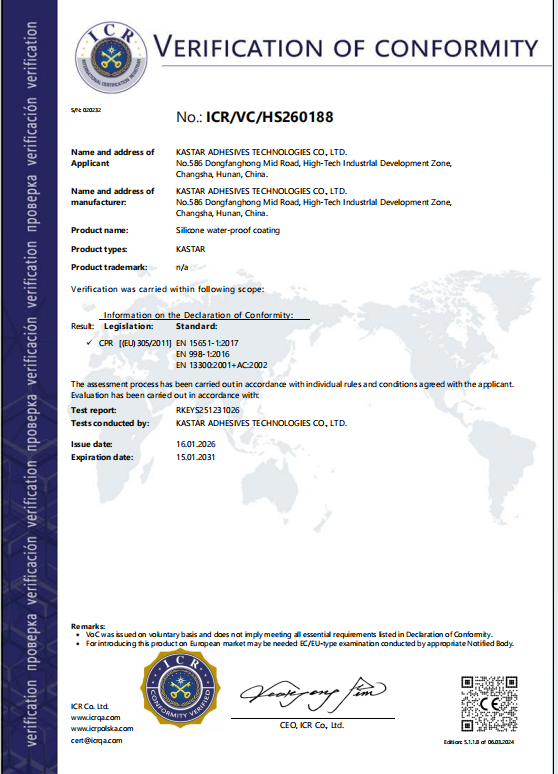
CE certificate ICR/VC/HS260188, issued by ICR for the European market, valid from 2026-01-16 to 2031-01-15.
ISO 45001 — the factory-side factor that protects your brand
ISO 45001 is the international standard for occupational health and safety management systems, developed to replace the earlier OHSAS 18001 specification. It is voluntary rather than a market-entry requirement, which is precisely why it functions as a differentiator during supplier evaluation: any factory can claim to handle chemicals responsibly, but a management system standard requires documented hazard identification, defined controls, incident reporting, and periodic review.
For a coating importer, the relevance is not abstract. Silicone waterproof coating production involves bulk raw material handling, mixing, filling, and packaging — processes where solvent and additive exposure, dust, and machine safety are real operating risks. A supplier that manages those risks under a recognised framework is less likely to suffer the disruptions that reach the buyer: production stops after an incident, inconsistent batches during remedial periods, or reputational exposure when a distributor's own customers ask how the product was made.
ISO 45001 also supports brand protection in a second, less obvious way. Increasingly, distributors and brand owners are asked by their own retail, institutional, or public-sector customers to demonstrate supply chain responsibility. Being able to name the safety management framework used by the manufacturing site — and to show the certificate or audit record — shortens that conversation considerably.
Buyers should be precise about what they are verifying. Kastar's published documentation set covers ISO 9001, CE, SGS, and REACH. Where ISO 45001 status matters to a specific tender or buyer policy, it should be requested and confirmed directly with the manufacturer at the audit stage rather than assumed from a general sustainability statement.
What sits behind the certificates: the factory evidence
Certificates are only as good as the production system they describe, so the third layer of the checklist is factory evidence. Kastar's disclosed capability data includes three national-level R&D laboratories in China focused on silicone resins, silicone coatings, and MS coatings, staffed by 28 technical R&D personnel, plus a 1,000㎡ China Metrology Accreditation (CMA) certified sealing material testing laboratory with 16 testing personnel and more than 100 testing instruments and equipment.
The company reports 28 years of production experience, OEM production for more than 600 clients, exports to 69 countries and regions, and service to over 1,000 customers. Production documentation states that products pass through 12 production and testing processes from manufacturing to delivery, with batch sample testing used to maintain consistency across the run.
Step-by-Step: The Import Compliance Checklist
This sequence follows the order in which problems usually appear, from market definition through to shipment release. It is designed to be run before a purchase order, not after a container has left the port.
Step 1 — Define the destination market and its legal framework. Confirm whether the coating is entering the EU, North America, or another regulated market. The EU pathway is built on REACH plus CE conformity against named harmonized standards; the US pathway typically references ASTM C920 or ASTM C1184 for construction sealants and coatings. Two markets can mean two documentation sets for the same product.
Step 2 — Collect the chemical documentation first. Request the safety data sheet matching the exact product code, an SVHC declaration for the finished coating, and confirmation from the manufacturer that raw material suppliers provide substance-level statements. This is the document set most likely to be requested by customs and the least likely to be ready on short notice.
Step 3 — Verify the CE certificate on its merits. Check the certificate number, the issuing body, the standards referenced, the product name covered, the market, and both the issue and expiry dates. A certificate that expires mid-project, or that names standards unrelated to the product being shipped, creates a submittal problem later. Kastar 4000's CE file lists certificate ICR/VC/HS260188, issued by ICR, covering the European market under EN 15651-1:2017, EN 998-1:2016, and EN 13300:2001+AC:2002, valid to 2031-01-15.
Step 4 — Audit the management systems behind the product. Ask for ISO 9001 evidence for quality management and ISO 45001 status for occupational health and safety, and confirm the audit scope covers the actual production site. Where a live audit or remote factory review is possible, use it to check how raw materials are stored and handled and how batch records are retained.
Step 5 — Validate a sample and a batch record before committing. Ask for a physical sample from the production formulation, apply it to a representative substrate — roof membrane, exterior wall, or basement surface — and compare the batch test record against the specification sheet. Kastar's process is documented as 100% testing with batch sample testing across 12 production and testing stages, which gives the buyer a specific record to request rather than a general assurance.
Step 6 — Lock packaging, labelling, quantity, and lead time in writing. Compliance does not end at the certificate. Confirm the packaging format, label language, batch coding, minimum order quantity, and delivery window so that documentation and physical goods match on arrival. For Kastar 4000, the stated OEM/ODM terms include a minimum order quantity of 100 buckets, lead time of 15–20 days, monthly capacity of 30,000 tons, and customisation of colour, viscosity, packaging, and formulation.
Priority order: which document blocks a shipment first
When a buyer has limited time and an incomplete supplier file, the practical order of urgency usually runs as follows:
- CE certificate and its standard scope — without it, the product cannot be positioned as CE-marked in European construction specifications.
- REACH/SVHC declaration and matching safety data sheet — the most common customs and retail compliance request.
- Batch test report — the document that connects the certificate to the actual goods in the container.
- ISO 9001 evidence — the baseline proof of process consistency.
- ISO 45001 status — increasingly requested by institutional and public-sector end customers, and a strong indicator of site discipline.

Raw material handling and production discipline are the operating reality behind ISO 9001 and ISO 45001 documentation.
Use Cases: Where These Documents Decide the Outcome
European exterior wall and facade projects
For a distributor supplying exterior wall waterproofing in the EU, the CE certificate effectively replaces the argument. The specifier checks the standards referenced on the certificate, confirms the coating's UV and elongation performance against the project brief, and approves the submittal. Kastar 4000's file lists EN 15651-1:2017, EN 998-1:2016, and EN 13300:2001+AC:2002, with UV resistance of 1000 hours and elongation at break of at least 200% — data points a façade specifier can work with directly.
Basement and underground structure waterproofing
Basement work raises the consequence of failure: repairs are disruptive and expensive, and the coating must hold under sustained moisture rather than intermittent rain. Compliance documentation does not measure adhesion, but it does establish that the product behind the claim is the product being delivered — the same formulation, from the same audited process, supported by batch records. For importers, the ability to hand a contractor a consistent document set across repeat orders is often what converts a one-off purchase into a programme supply.
Roof projects in extreme climates
Roof coatings in high-UV or high-thermal-cycling regions are specified on durability. Kastar 4000 is described as a one-component silicone waterproof coating with a solid content of 98%, tensile strength of at least 1.2 MPa, and an outdoor service life of at least 25 years. Reported project results include CE-compliant products adopted in EU, North America, and Southeast Asia construction projects, with waterproof performance maintained under extreme weather and effective prevention of water leakage and structural damage.
Distributor private-label entry
A distributor launching a private-label silicone waterproof coating must transfer compliance, not just product. That means the certificate has to cover the formulation being supplied, the labelling has to match the destination market, and the OEM partner has to be able to repeat the same document set on every production run. Kastar's OEM/ODM support covers colour, viscosity, packaging, and formulation adjustment, with customisable colours and packaging specifications — the practical levers a distributor needs to build a branded range without rebuilding the compliance file from scratch each time.
Compliance Frameworks Compared
The table below summarises the five verification layers an importer is most likely to encounter, what each one covers, and the consequence of a gap.
| Framework | What it covers | Document to request | Market relevance | Risk if missing |
|---|---|---|---|---|
| REACH | Chemical substances in raw materials and finished goods; restricted list and SVHC screening | SVHC declaration, safety data sheet matching the product code, raw material substance statements | European Union | Customs or retail compliance hold, re-testing cost, delayed launch |
| CE marking | Conformity with the harmonized standards named on the certificate | Certificate ICR/VC/HS260188 issued by ICR, referencing EN 15651-1:2017, EN 998-1:2016, EN 13300:2001+AC:2002, valid 2026-01-16 to 2031-01-15 | Europe | Specification submittal blocked; product cannot be presented as CE-marked |
| ISO 9001 | Quality management system at the manufacturing site | Valid certificate plus audit scope confirmation | Global | Buyers cannot verify process consistency across batches |
| ISO 45001 | Occupational health and safety management system, including chemical hazard control | Certificate or audit record, confirmed directly with the manufacturer | Global (voluntary) | Higher perceived people and handling risk; weaker position in responsible-sourcing tenders |
| SGS / third-party testing | Independent verification of product or batch characteristics | Test report reference tied to the batch | Global | Limited independent evidence behind supplier performance claims |
Project specifications in the United States typically reference ASTM C920 for elastomeric joint sealants or ASTM C1184 for structural applications, which is why US-bound importers should request that standard set in addition to any European documentation.
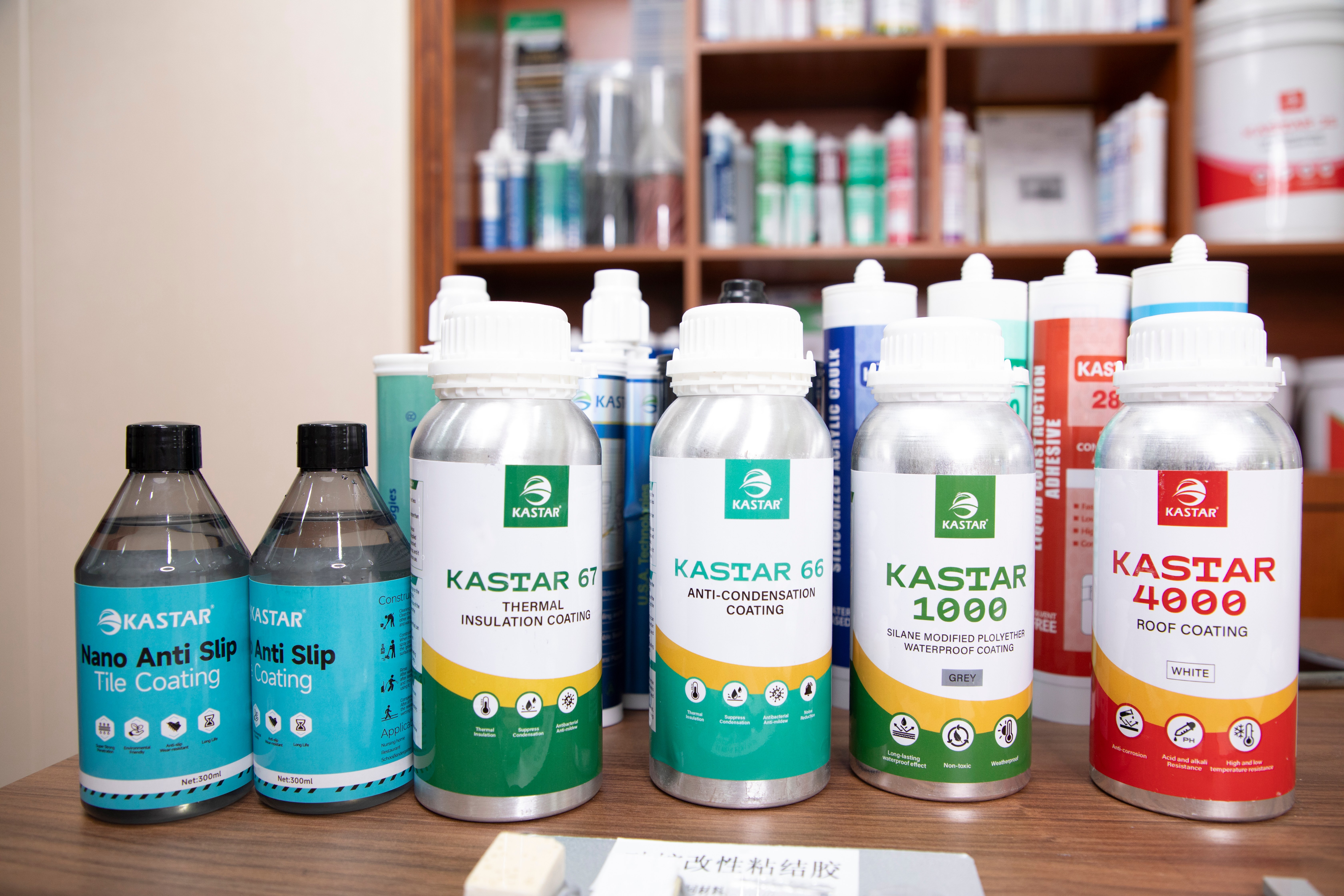
Sample validation before a bulk order connects the certificate to the physical product the importer will sell.
Frequently Asked Questions
Is CE marking mandatory for importing silicone waterproof coating into the EU?
CE marking applies to construction products that fall within the scope of a harmonized European standard or a European Technical Assessment. Because scope is product-specific, the practical answer is to verify what the certificate actually covers rather than assume a category-wide rule. For the Kastar 4000 Silicone Waterproof Coating, the CE file lists certificate ICR/VC/HS260188 issued by ICR for the European market, referencing EN 15651-1:2017, EN 998-1:2016, and EN 13300:2001+AC:2002, issued 2026-01-16 and valid to 2031-01-15. Importers should confirm the product name, standards, and validity dates match the goods being shipped.
Can an OEM/ODM supplier support the compliance documentation for a private-label import?
Yes, provided the compliance file transfers with the formulation. Kastar operates an OEM/ODM model with customisation of colour, viscosity, packaging, and formulation, and its published certification set covers SGS, REACH, ISO 9001, and CE for the relevant product. A distributor building a private label should confirm in writing that the certificate scope covers the customised formulation, that labelling and batch coding meet the destination market's requirements, and that the same document set can be repeated on each production run.
What drives cost in a compliant bulk silicone waterproof coating order?
Four cost variables dominate: formulation and raw material selection, packaging format and labelling, testing and documentation effort, and order volume. Kastar's stated OEM/ODM terms include a minimum order quantity of 100 buckets, a lead time of 15–20 days, and monthly capacity of 30,000 tons, which means volume planning directly affects unit economics. Buyers comparing quotations should compare the full document package and testing scope alongside the price, since re-testing or re-labelling after arrival is usually more expensive than paying for it at the factory.
How should an importer validate a coating before placing a full order?
Request a sample drawn from the production formulation, apply it to a substrate representative of the target application — roof, exterior wall, or basement surface — and compare the batch test record with the specification sheet. Kastar's production documentation describes 100% testing with batch sample testing across 12 production and testing stages, and the company operates a 1,000㎡ CMA-certified sealing material testing laboratory with 16 testing personnel and more than 100 testing instruments. Sample validation is also the point at which a distributor can confirm which customisation options are realistic for the volume being ordered.
What is the typical lead time, and does compliance work extend it?
Kastar states a lead time of 15–20 days for OEM/ODM production, with monthly capacity of 30,000 tons and a minimum order quantity of 100 buckets. Compliance work affects lead time mainly at the front end: collecting the safety data sheet, SVHC declaration, CE certificate details, and batch records takes longer than most new buyers expect. Building that document set during sampling, rather than after the purchase order, is the simplest way to protect the delivery window. Importers who want to start that process can request a sample, a quotation, or the product catalogue as a first step.
Conclusion: Compliance as the First Purchasing Decision
For silicone waterproof coating imports, compliance is not a formality that follows the commercial decision — it is the decision. REACH determines whether the chemistry can enter the market, CE determines whether the product can be specified by name, and ISO 9001 and ISO 45001 determine whether the factory behind it will still be supplying the same product, made the same way, in three years.
The checklist in this article reduces to five verifiable items: a chemical declaration tied to the exact product code, a CE certificate whose number, standards, and validity dates hold up to scrutiny, a batch test record that connects the certificate to the delivered goods, a documented quality management system, and a clear position on occupational health and safety at the manufacturing site. Kastar's file covers CE under certificate ICR/VC/HS260188 (valid 2026-01-16 to 2031-01-15), REACH, SGS, and ISO 9001, backed by a 150,000㎡ manufacturing site, a 1,000㎡ CMA-certified testing laboratory, and OEM/ODM terms including a 100-bucket minimum order quantity and a 15–20 day lead time.
Buyers who ask for these documents before they negotiate price consistently find the evaluation stage shorter — because the questions that would otherwise surface at the port, at the submittal desk, or on the roof have already been answered.

Bulk stock and batch records prepared for export once the compliance file is complete.
Request the Compliance File, Sample, or Quotation
Kastar Adhesives Technologies Co., Ltd supplies silicone waterproof coating and OEM/ODM production for distributors, importers, and brand owners, with documented CE, REACH, SGS, and ISO 9001 certification. To review the technical data, request a sample from the production formulation, or discuss bulk terms, contact the team directly.
Visit kastarcoating.comDownload the Product Brochure
Email: paint4566@kastarpaint.com | Tel / WhatsApp: +86 15974221507 | Contact: Nicole
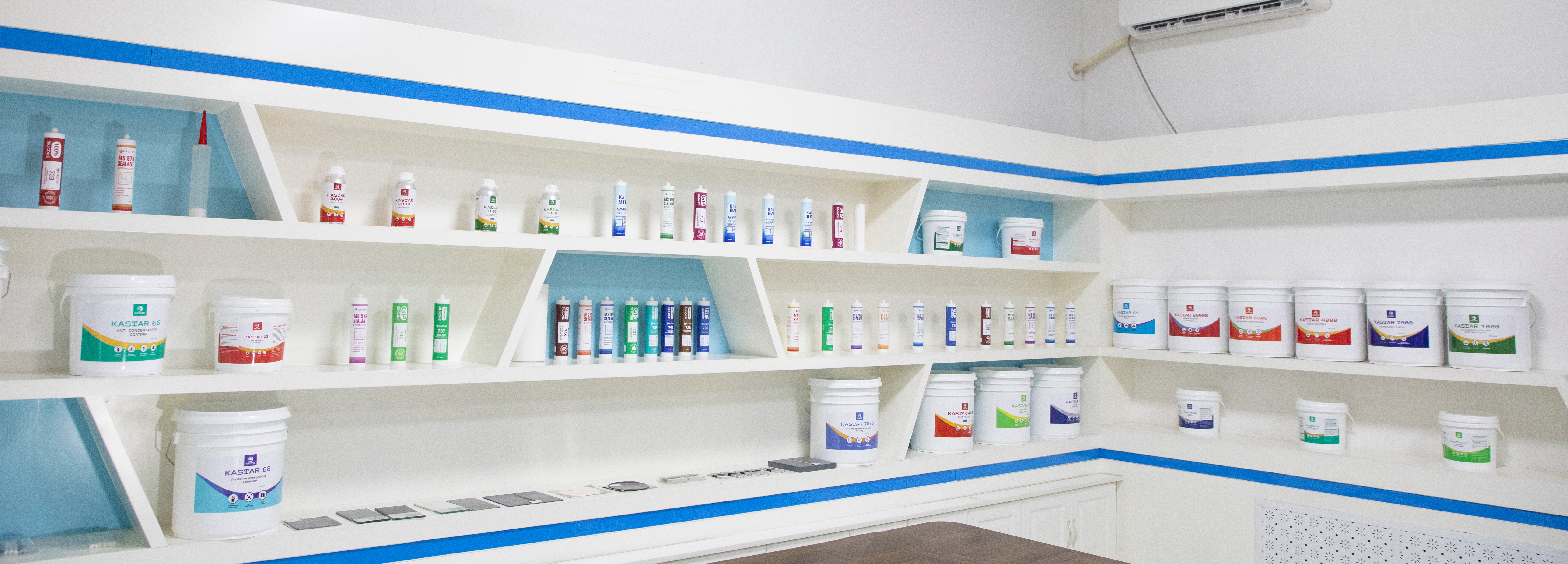
Sampling and product validation support for distributors evaluating a silicone waterproof coating supply partner.