- FAQ
- 113
Silicone vs. Acrylic Roof Coating: A Head-to-Head Decision for Export Buyers
Silicone vs acrylic roof coating compared for export buyers: ASTM D6694 performance floors, VOC and odour profiles, OEM/ODM entry models and a five-criterion decision rubric.
Silicone vs. Acrylic Roof Coating: A Head-to-Head Decision for Export Buyers
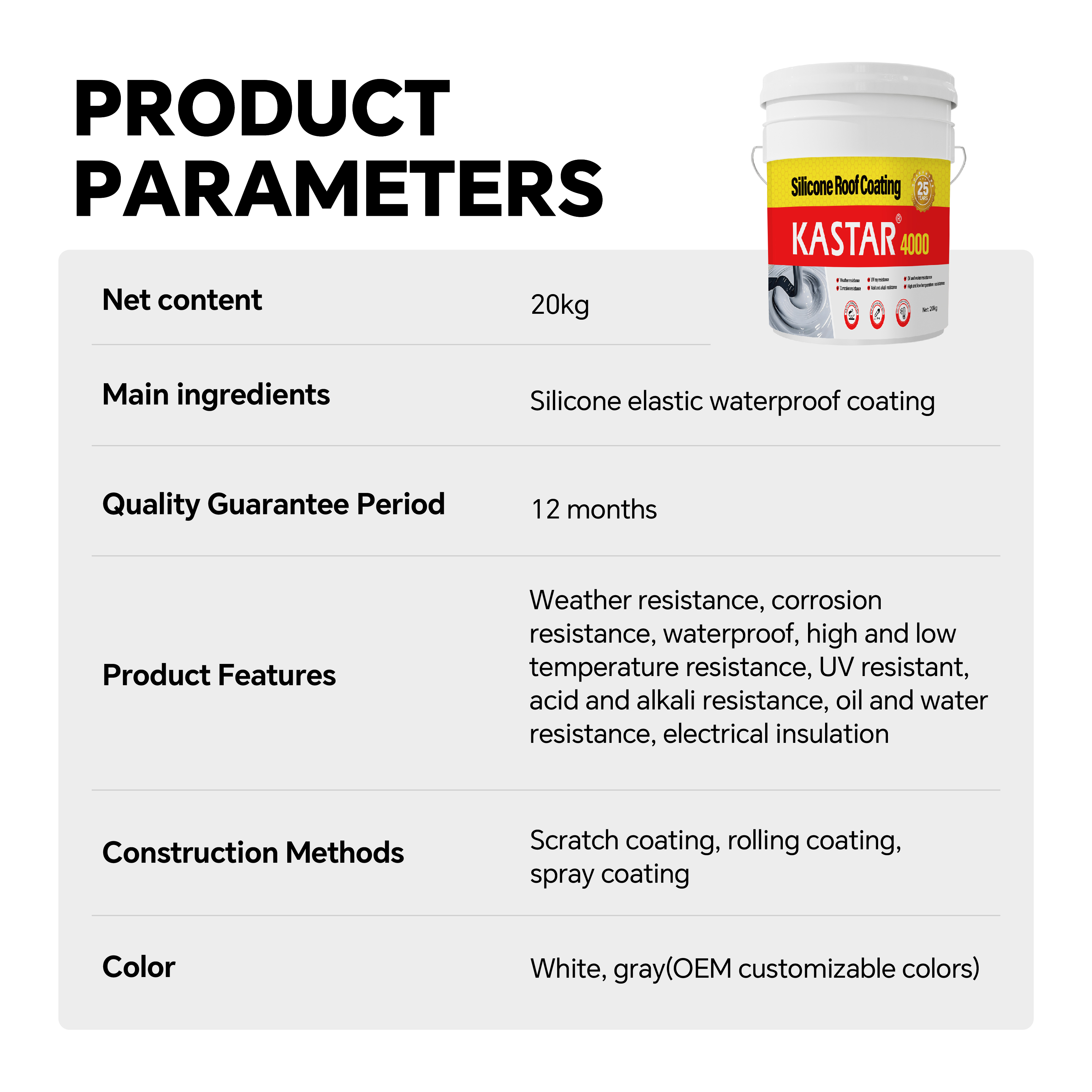
Kastar 4000 Silicone Waterproof Coating: one-component, UV-resistant, 98% solids. Source: Kastar product specification.
Choosing between a silicone roof coating and an acrylic roof coating is not a brand decision. It is a documentation and life-cycle decision. Silicone systems are generally specified where sustained UV exposure, thermal movement and a long recoat interval dominate the cost model. Acrylic systems are generally specified where a water-borne carrier, a lower initial material cost and vapour permeability dominate. On the same roof, across the same ten years, the two rarely produce the same result.
Kastar Adhesives Technologies Co., Ltd., established in 1998, is a China-based OEM/ODM manufacturer of coating, paint, sealant and adhesive products. It produces silicone waterproof coating, epoxy colour sand floor coating and MS sealant at a 150,000㎡ facility with an annual production capacity of 300,000 tons, and exports to 69 countries and regions. Its Kastar 4000 Silicone Waterproof Coating is used here as the worked silicone example, because its published figures can be checked line by line against ASTM D6694/D6694M-25 instead of being accepted on trust.
Short answer: if the roof is exposed, the climate is UV-heavy, and the importing market demands a documented compliance file, silicone is the default and acrylic is the challenger that has to prove itself. If the surface is protected, the budget is fixed, and the buyer needs a water-borne film with low odour during application, acrylic stays in the running. Fix the exposure first. The chemistry follows.
Problem Definition: Why This Comparison Is Harder for Export Buyers
A local contractor compares two pails on one roof. An exporter compares two systems across a regulatory file, a container plan, a warranty position and a distributor's shelf. That difference is where most of the risk sits.
1. The specification problem: the figures are not on the same basis
Technical datasheets from different manufacturers frequently report elongation at different test conditions, tensile on different film builds, and UV resistance as either hours in a weathering chamber or an unqualified service-life claim. Unless the buyer normalises the numbers before comparing, the comparison is decorative rather than decisive. ASTM D6694/D6694M-25 is useful precisely because it removes that ambiguity for liquid-applied silicone roof coatings: it sets a minimum tensile strength of 150 psi and a minimum elongation of 100%.
2. The compliance problem: company-level claims do not transfer to every SKU
A statement that a manufacturer holds ISO9001, CE, SGS and REACH certifications is an entry ticket, not an answer to an importer's question. Importers need the certificate scope, the validity date, the issuing body and, for REACH and volatile-content questions, the SDS and test report for the exact product being shipped. VOC and odour profiles are chemistry questions as much as paperwork questions: a high-solids silicone coating and a water-borne acrylic coating reach the same "low odour" marketing claim through very different physical mechanisms.
3. The channel problem: OEM, private label and agency are three different decisions
A distributor evaluating a roof coating is not only choosing a polymer. It is choosing whether to sell under its own brand, whether to sell the manufacturer's brand, and how much of the packaging and formula it wants to control. Kastar lists a custom-brand OEM starting quantity of 5,000 units and a KASTAR brand agency starting quantity of 1,000 units. Those are two different commercial routes and should not be compared as if they were the same MOQ.
Industry Background: What the Data and the Standards Actually Support
Silicone waterproof coating supplied for building waterproofing and roofing engineering.
The commercial weight of this category is documented. Market.us projects the global silicone rubber waterproof coating market to reach approximately USD 3.5 billion by 2034, and reports that Asia-Pacific holds a 45.9% revenue share of that market. For a buyer, the Asia-Pacific share matters more than the headline figure: it indicates that a large part of the supply base the buyer will negotiate with sits in the region where the category is most concentrated.
Two cautions belong with those figures. First, published market-size estimates vary substantially depending on whether a study counts only construction waterproofing elastomers or includes broader industrial, automotive and electronic silicone coatings. Treat any single number as directional and check the scope before it enters a business case. Second, market growth says nothing about whether a specific product will survive a specific roof. That question is answered by specification data, and for silicone roof coatings the reference point is ASTM D6694/D6694M-25.
Against that floor, the Kastar 4000 specification can be read directly: tensile strength ≥1.2 MPa (roughly 174 psi), elongation at break ≥200%, UV resistance of 1000 hours without cracking or peeling, an operating temperature range of −80°C to 180°C, a solid content of 98%, and a stated outdoor service life of ≥25 years. Both the tensile and elongation figures sit above the ASTM D6694 minimums. That does not make the product suitable for every roof; it makes it comparable, which is the more useful property in a procurement file.
Detailed Solution: A Five-Criterion Decision Rubric
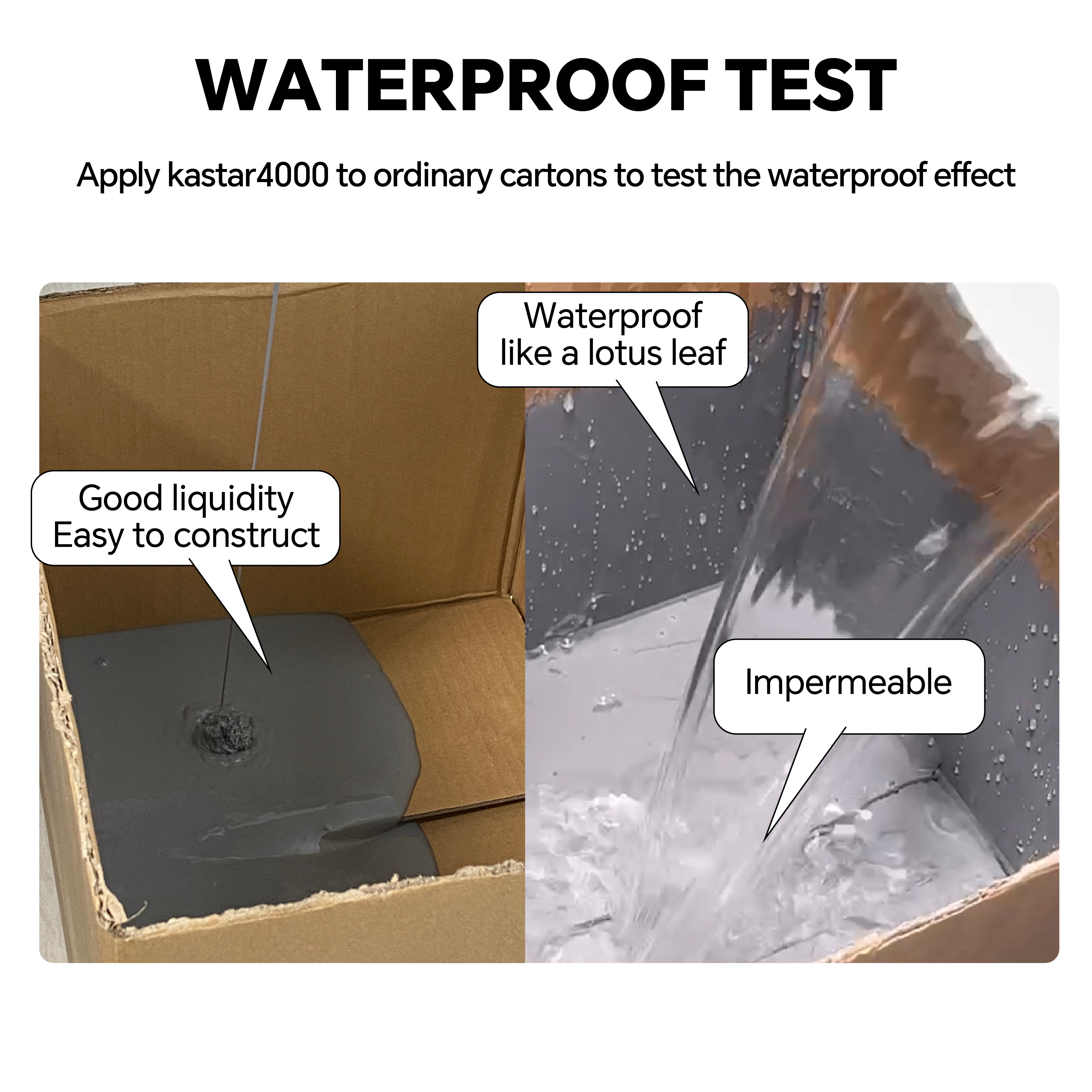
A cured silicone waterproof coating forms a seamless, UV-resistant film rather than a joined sheet system.
The rubric below is written for the buyer who has to defend the decision internally, not for the buyer who wants a slogan. Each criterion is scored against the same evidence for both chemistries.
Criterion 1 — Exposure: is the film actually exposed?
This is the first criterion because it eliminates most bad comparisons. Kastar markets Kastar 4000 specifically for exposed building roofs, and lists a separate product, KASTAR 3000 Silicone Elastic Exterior Wall Waterproof Coating, for exterior walls. Where the roof is directly exposed to sun, rain and thermal cycling, the specification should be judged on UV resistance and retention of elasticity. Where the surface is shielded, the UV argument weakens and the acrylic case becomes more competitive on cost and application profile.
Criterion 2 — Movement: read tensile and elongation together
A roof does not only get wet; it moves. Elongation tells the buyer how far the film can stretch before it fails, and tensile strength tells the buyer how much stress it carries while doing so. A coating with high elongation and negligible tensile strength is a soft film; a coating with high tensile strength and low elongation is a brittle one. ASTM D6694 sets 150 psi and 100% as the floor for silicone roof coatings; Kastar 4000 is specified at ≥1.2 MPa tensile and ≥200% elongation, which is the pairing a specifier should look for when thermal cycling is the dominant failure mode.
Criterion 3 — Durability evidence: hours, not adjectives
Ask for a test duration and a pass criterion. Kastar specifies 1000 hours of UV exposure with no cracking or peeling, and a service life of ≥25 years outdoors. Both are manufacturer-stated figures, and a buyer should map them to its own project protocol rather than treating them as a warranty. The equivalent question for an acrylic supplier is the same: how many hours, under which standard, and what constitutes failure. A supplier that cannot answer in those terms has not yet given the buyer anything comparable.
Criterion 4 — Carrier and odour: compare solids, then request the SDS
This is where the low-odour and low-VOC argument is won or lost. Kastar 4000 is a one-component, silicone-based, UV-resistant waterproof coating with a solid content of 98%. High solids mean that most of what is applied stays on the roof as film rather than leaving as carrier. Most roof-grade acrylics are water-borne emulsions, which is why acrylic is often associated with easier odour conditions on occupied buildings — but water-borne is not automatically low in volatile content once coalescents and additives are counted. The only defensible comparison is the SDS and the product-specific test report, side by side, for the two exact SKUs under consideration. Kastar reports ISO9001, CE, SGS and REACH certification for its products; a buyer should request the certificate scope and the report for the specific SKU, since a company-level statement does not automatically cover every item in a range.
Criterion 5 — Commercial model: does the supplier support the channel you sell through?
Technology that cannot be packaged for your market is not a sourcing solution. Kastar provides OEM and ODM services for silicone waterproof coatings, including custom branding and packaging design, with customization of colour, viscosity, packaging and formula adjustments. For a distributor building a private label, that flexibility is the difference between reselling a product and owning a brand.
Where silicone wins
- Exposed roofs where UV exposure and thermal movement drive the failure mode.
- Projects where a long recoat interval reduces access cost and disruption.
- Markets where the importer requires a documented performance and compliance file at SKU level.
- Programmes where the distributor needs OEM/ODM customization rather than a catalogue item.
Where acrylic wins
- Protected or lightly exposed surfaces where the UV argument is secondary.
- Applications where a water-borne carrier is the practical route to an acceptable odour profile on an occupied building.
- Price-sensitive volume work where the buyer has accepted a shorter recoat cycle.
- Situations where the local supply chain for acrylic is materially simpler than for silicone.
Limits of this comparison
Two limits should be stated openly. First, this article does not establish that either chemistry is universally superior; the correct answer depends on exposure, substrate and the importer's regulatory file. Second, below-grade use is not covered by the application evidence presented here. If a buyer is specifying a basement, the silicone-versus-acrylic question has to be answered with project-specific data and a supplier's written position on hydrostatic conditions, not with a roof comparison.
| Decision criterion | What a pass looks like | Evidence to file |
|---|---|---|
| Exposure | Product is specified for the actual surface, not a generic roof | Datasheet application statement |
| Movement | Tensile and elongation both above ASTM D6694 (150 psi / 100%) | TDS figures plus test method reference |
| Durability | Stated UV hours with a defined failure criterion | Weathering test report |
| Carrier and odour | Solids content and volatile profile known for the exact SKU | SDS plus product-specific test report |
| Commercial model | Starting quantity and customization scope confirmed in writing | Quotation and OEM/ODM terms |
Rubric thresholds reference ASTM D6694/D6694M-25 and Kastar's published Kastar 4000 specification.
Step-by-Step Breakdown: Running the Comparison in Seven Steps
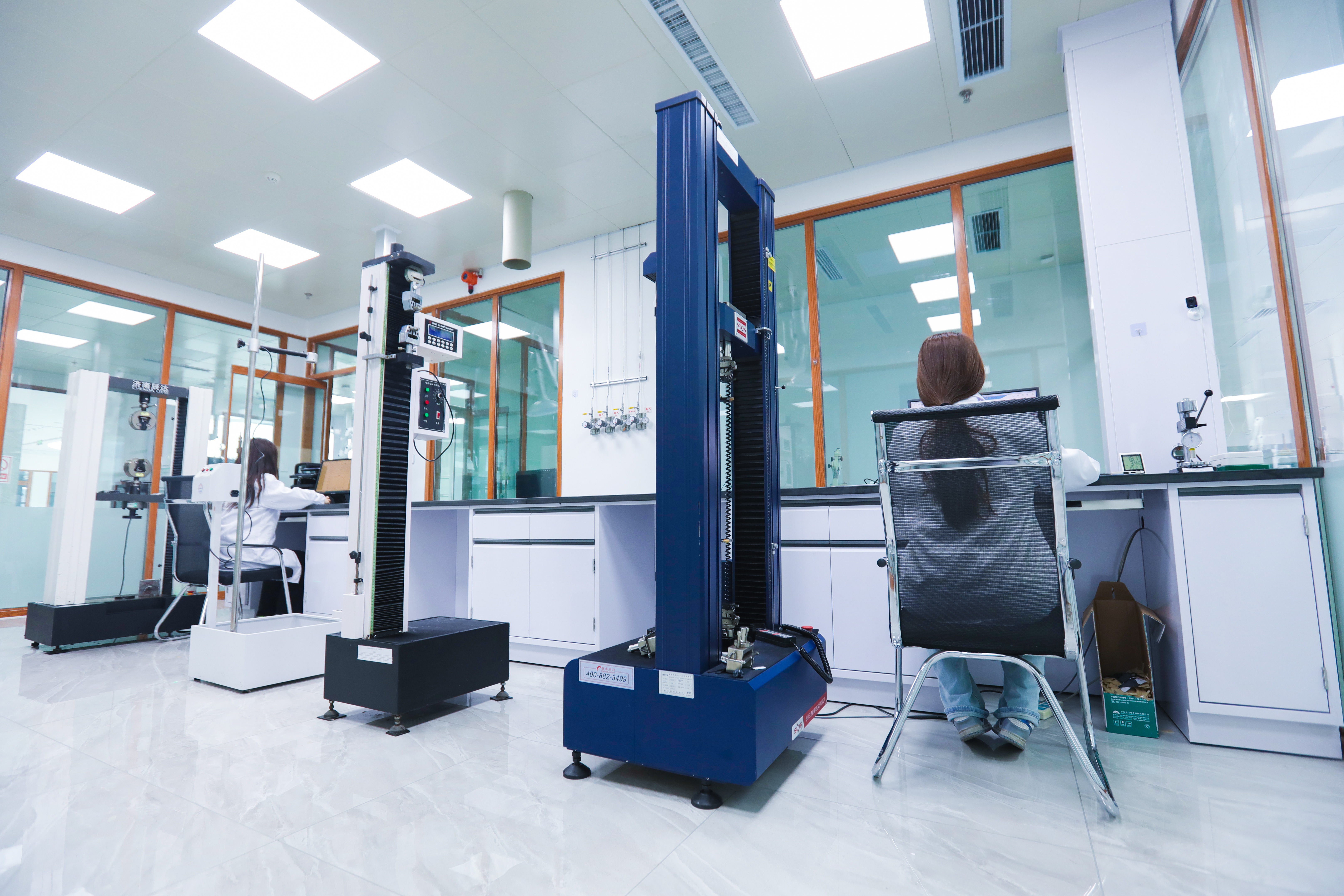
Kastar operates a 1000㎡ China Metrology Accreditation (CMA) certified sealing material testing laboratory.
- Define the exposure in writing. Record substrate, orientation, sun hours, rain exposure and whether the surface is occupied during application. This single document decides most of the silicone-versus-acrylic debate.
- Request two datasheets on the same template. Ask both suppliers for tensile, elongation, solids, UV test hours, service-life statement, application method and recommended consumption, each with the test method named.
- Check both products against ASTM D6694/D6694M-25. A silicone coating below 150 psi tensile or 100% elongation is outside the recognised floor, whatever the marketing page says.
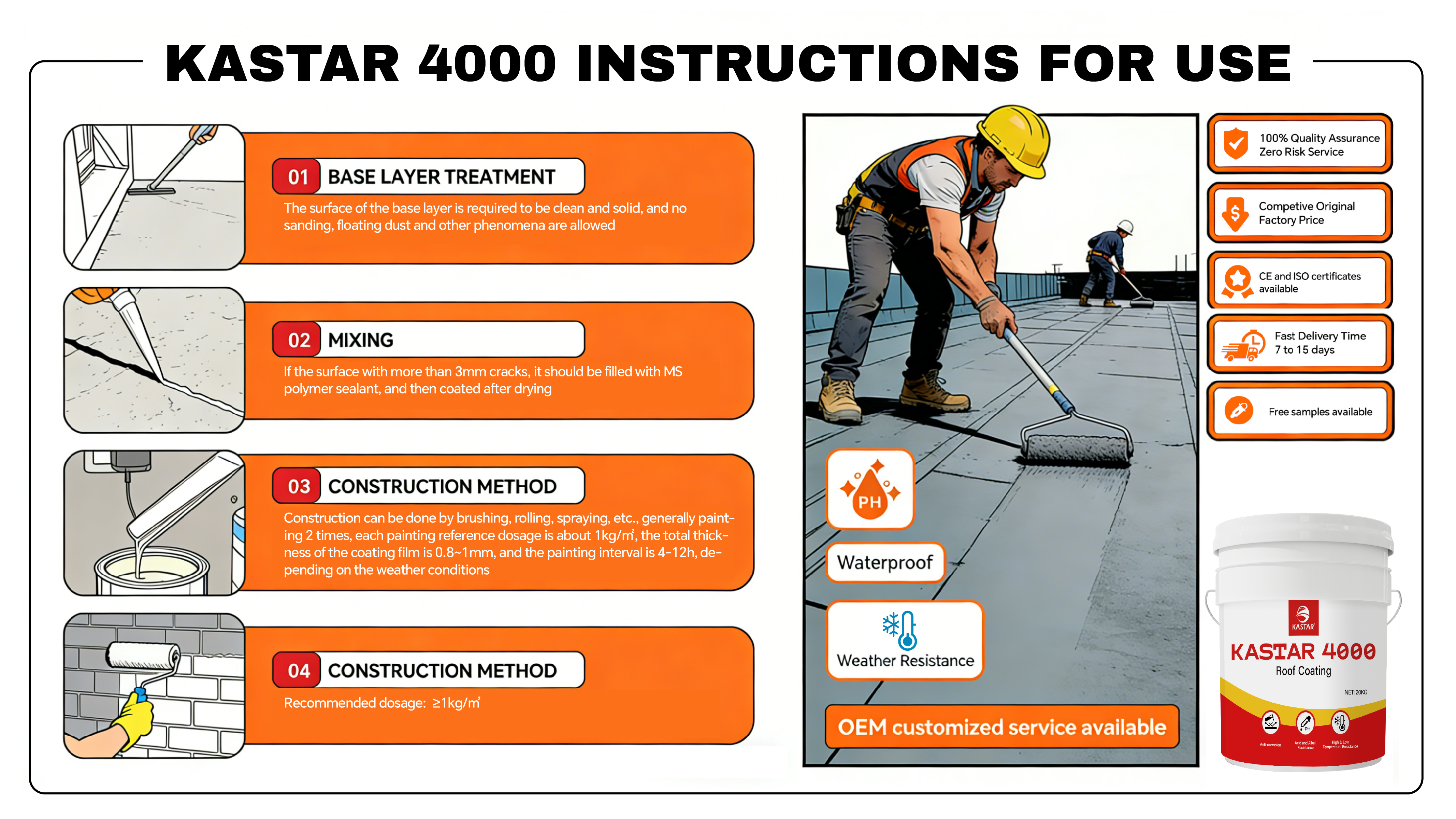
- Model consumption, not just price per pail. Kastar's published construction guidance for its silicone elastic waterproof coating gives a reference dosage of approximately 1 kg/m² per coat, generally two coats, with a total film thickness of 0.8–1 mm and an interval of 4–12 hours between coats depending on weather. Apply the same two-coat logic to the acrylic control and compare total material per square metre.
- Choose the commercial model before the artwork. Decide whether the programme is a custom-brand OEM build (Kastar lists 5,000 units as the starting quantity) or a branded agency arrangement (1,000 units), because the packaging, label approval and stocking plan differ.
- Run a side-by-side site trial. Use the same substrate, the same applicator and the same two-coat schedule. Record odour observations during application and curing, because odour is a site condition that no datasheet can fully predict.
- Freeze the specification and the repeat-order parameters. Colour, viscosity, packaging, label and batch documentation should be fixed in the purchase agreement so that the second container matches the first. Kastar runs production through 12 production and testing processes with batch sample testing, and independently develops the fully automated packaging equipment used on its lines.
Use Cases: Where the Decision Lands in Practice
Roof waterproofing and exterior wall waterproofing are the two primary application routes for silicone waterproof coating.
Exposed building roofs. Kastar 4000 is specifically developed for exposed building roofs, where UV resistance of 1000 hours without cracking or peeling and an operating range of −80°C to 180°C address the two dominant stressors. This is the scenario in which silicone most clearly outperforms acrylic on specification grounds.
Exterior walls. KASTAR 3000 Silicone Elastic Exterior Wall Waterproof Coating covers the vertical surface case in the same portfolio, which lets a distributor build a two-SKU line rather than a single-item offer. Buyers should still confirm the individual datasheet, since roof and wall exposure are not equivalent.
Basements and below-grade work. This is where the comparison should stop and be rebuilt on project data. The evidence supporting a roof comparison does not automatically validate a below-grade specification, and a buyer should require a supplier's written position on hydrostatic conditions before committing.
Export destinations. Kastar's silicone waterproof coating applications are common in countries including the United States, Canada, Australia, the Netherlands and Thailand, and the company's major markets include the United States, Canada, Australia and New Zealand. For buyers in those markets, the practical difference between the two chemistries is often documentation depth rather than polymer chemistry: an importer with an established compliance workflow will ask for the report, not the brochure.
Silicone vs. Acrylic Roof Coating: Comparison Table
| Dimension | Silicone roof coating | Acrylic roof coating |
|---|---|---|
| Base chemistry | Kastar 4000 is a one-component silicone waterproof coating whose primary material is silicone | Acrylic polymer system; most roof-grade products are water-borne emulsions — confirm per TDS |
| Standard performance floor | ASTM D6694: ≥150 psi tensile, ≥100% elongation | No single equivalent floor cited in this evidence set; require the supplier's named test standard |
| Kastar 4000 figures | Tensile ≥1.2 MPa; elongation ≥200%; UV 1000 h no cracking or peeling; service life ≥25 years outdoor | Not applicable — request equivalent figures from the acrylic supplier |
| Carrier and solids | Solid content 98% | Water-borne carrier in most roof grades; volatile profile depends on coalescents — check SDS |
| Odour during application | High-solids system; odour assessment should be based on the SDS and a site sample | Generally easier on occupied buildings, but not automatically low in volatile content |
| Temperature range | −80°C to 180°C (Kastar 4000) | Verify per TDS; water-borne acrylic films are commonly specified in narrower service windows |
| Application method | Brush, roller or spray; reference two coats at ~1 kg/m² per coat, 0.8–1 mm total, 4–12 h interval (Kastar construction guidance) | Typically brush, roller or spray; confirm coverage and interval per TDS |
| Documentation | Kastar reports ISO9001, CE, SGS and REACH certification; request SKU-level scope and validity | Supplier-specific; certificates do not transfer between products or suppliers |
| Commercial entry | OEM/ODM available: custom brand from 5,000 units; KASTAR brand agency from 1,000 units | Supplier-dependent; request MOQ by SKU and packaging format |
| Strongest fit | Exposed roofs, high-UV climates, thermal cycling, long recoat interval | Protected or lightly exposed surfaces, odour-sensitive occupied buildings, cost-driven volume work |
Silicone entries use Kastar's published Kastar 4000 specification and ASTM D6694/D6694M-25. Acrylic entries describe the general industry profile of the chemistry and should be confirmed against a specific supplier's technical datasheet.
FAQ
Does a silicone roof coating meet export compliance requirements better than acrylic — and what documentation should a buyer demand?
Neither chemistry is automatically compliant; compliance is a documentation question. ASTM D6694/D6694M-25 sets a minimum tensile strength of 150 psi and minimum elongation of 100% for liquid-applied silicone roof coatings, which is the performance floor most specifiers reference. Kastar reports ISO9001, CE, SGS and REACH certification for its products. Before a purchase order, request the product-specific test report, the certificate scope and validity date, and the REACH-oriented SDS for the exact SKU, because a company-level claim does not automatically transfer to every product in a range.
Can a silicone waterproof coating be supplied as OEM/ODM with custom colour, viscosity and packaging?
Yes. Kastar provides OEM and ODM services for silicone waterproof coatings, including custom branding and packaging design, with customization of colour, viscosity, packaging and formula adjustments. Kastar 4000 itself is a one-component, silicone-based, UV-resistant waterproof coating, and customization sits on top of that base formulation. Buyers should confirm in writing which parameters are adjustable for the target SKU before printing artwork.
What order size does a private-label silicone coating programme require, and how does that differ from distributing the Kastar brand?
Kastar lists a custom-brand OEM starting quantity of 5,000 units and a KASTAR brand agency starting quantity of 1,000 units. These are two different commercial models — private label versus brand agency — and should not be compared as if they were the same MOQ. For budgeting, combine the starting quantity with the reference consumption of approximately 1 kg/m² per coat applied in two coats at 0.8–1 mm total film thickness, then convert to project area rather than unit count.
How should an export buyer validate silicone versus acrylic before committing to a container?
Run a side-by-side trial on the actual substrate rather than a generic panel. Kastar's published construction guidance lists brush, roller and spray application, two-coat application, 0.8–1 mm total thickness and a 4–12 hour interval between coats depending on weather; the same schedule can be applied to an acrylic control sample for a fair comparison. Kastar's production runs through 12 production and testing processes with batch sample testing, and samples or batch documentation can be requested through paint4566@kastarpaint.com or +86 15974221507.
What determines lead time on a bulk silicone coating order, and how can it be shortened?
Lead time is driven by packaging configuration, colour and viscosity customization, order volume and the batch testing cycle rather than by the base polymer alone. Kastar's annual production capacity of 300,000 tons and 150,000㎡ facility support volume orders, and the company reports stable formulas and timely delivery; the schedule for a specific SKU should be confirmed at RFQ. The practical shortcut is to freeze the specification early — packaging, colour and label artwork — so production is not re-planned after the order is placed. To start a sample request or quotation, contact Nicole at paint4566@kastarpaint.com or +86 15974221507.
Conclusion
The silicone-versus-acrylic decision is settled by exposure and documentation, not by preference. Where a roof is directly exposed to UV and thermal cycling, a silicone system specified above the ASTM D6694 floor — tensile and elongation both — is the defensible choice. Where the surface is protected, the budget is tight and odour control on an occupied building is the dominant constraint, acrylic remains a legitimate option that should be judged on the same evidence template.
For buyers who need both the performance file and the channel flexibility, Kastar's position is straightforward to check: Kastar 4000 is specified at ≥1.2 MPa tensile, ≥200% elongation, 1000 hours UV resistance without cracking or peeling, 98% solids and a stated outdoor service life of ≥25 years, and the company backs it with ISO9001, CE, SGS and REACH certification, OEM/ODM customization, and a stated capacity of 300,000 tons per year. The roofing and waterproofing coatings range lists the roof and exterior wall SKUs side by side, so a buyer can build a two-SKU line from one supplier file.
Next step: compare on your own roof, not on a brochure
Request a Kastar 4000 sample and the SKU-level test documentation, and run it against your current acrylic specification using the rubric above. For a quotation, OEM/ODM discussion or the full product catalogue, contact Nicole at paint4566@kastarpaint.com, call or WhatsApp +86 15974221507, or download the Kastar product catalogue (PDF).