- FAQ
- 968
Viscosity, Solids & Cure: A Technical Guide to Silicone Waterproof Coating OEM Parameters
A technical guide to silicone waterproof coating OEM parameters — viscosity, solids content, cure profile, adhesion and VOC/odor targets — and how to build a factory-ready specification with Kastar.
Viscosity, Solids & Cure: A Technical Guide to Silicone Waterproof Coating OEM Parameters

Parameter verification starts in the laboratory, not on the job site. Kastar R&D laboratory, China.
A silicone waterproof coating is only as reliable as the specification written behind it. For OEM and ODM buyers who are already at the decision stage, the useful question is not "is this a good coating?" but "what exactly is written into the specification, and can the factory reproduce it on every batch?"
This guide works through the five parameters that carry the most commercial weight in a silicone waterproof coating OEM specification — viscosity, solids content, cure profile, adhesion, and VOC/odor targets — and shows how to translate a project's real conditions into a factory-ready document. It also explains how Kastar supports that process through 28 R&D engineers, 3 national-level R&D laboratories, an invention patent covering silicone waterproof coating processes, and a 1,000 m² CMA-certified testing laboratory.
Quick answer: specify the substrate and service environment first, then convert them into five measurable parameters, then require a batch sampling plan and a traceability record. A silicone waterproof coating OEM specification is complete only when a third party could test a delivered batch against it without asking follow-up questions.
The Problem: A Product Name Is Not a Specification
Two silicone waterproof coatings can carry the same product name, the same certification list, and the same application description while behaving differently on site. One flows into a hairline crack and stays there; another sags off a vertical wall before it cures. One skins over in a working window long enough for a two-person crew; another sets faster than the crew can finish the second coat.
The mismatch appears at the worst moment — after the coating has been applied, or after the buyer has committed to a container load. It shows up as uneven coverage, blistering on a sun-exposed roof, or a batch that cures to a different hardness than the sample approved three months earlier.
Three failure patterns account for most of this friction:
- Undefined parameters. The purchase order states a product name and a quantity. Viscosity, solids content and cure profile are never written down, so nothing can be measured on arrival.
- Copied specifications. A specification template from a different project is reused without re-checking it against the current substrate, climate, or application method.
- Unverified consistency. The sample performs correctly, but no sampling plan, no test record and no traceability system links the sample batch to the production batch.
For a distributor or brand owner, each of these becomes a commercial risk rather than a technical footnote: returns, rework, warranty exposure, and reputation with the contractor who applied the product.
Industry Background: Why Parameter Discipline Is a Buying Issue Now
The global silicone coating market was estimated at approximately USD 8.77 billion in 2024 and is projected to reach USD 11.27 billion by 2033, according to Grand View Research. Within that figure, the silicone roof coatings segment alone was valued at USD 7.03 billion in 2024 by Credence Research — a reminder that most of this demand sits on large, exposed surfaces where a coating cannot be quietly swapped out later.
Two further data points explain the direction of OEM buying. Asia-Pacific dominated the silicone coating market in 2025 with a 38.5% revenue share, according to Dataintelo, which is why so much custom formulation capacity now sits inside Chinese manufacturing. And 100% silicone elastomeric coatings held a 41.02% share of the composition-type segment in 2025, per Mordor Intelligence, driven by waterproofing and UV resistance.
Regulation is moving in the same direction. Solvent-less and UV-cured silicone formulations can reduce VOC emissions by 60–80% compared to traditional solvent-based platforms. For projects in the United States and Europe, ASTM C920 (Standard Specification for Elastomeric Joint Sealants) and ASTM C1184 for structural applications are the reference standards most often requested in tender documents.
The practical consequence for buyers is that silicone waterproof coating is increasingly specified as a system — formulation, parameters, test method, certification and packaging — rather than as a commodity pail. That shift is what makes a written OEM parameter specification commercially valuable.
The Five Parameters That Decide Performance
Each of the following parameters controls a different behavior. None of them can be judged in isolation — raising solids content changes film build, which changes the working window, which changes how the crew applies the coating.
1. Viscosity
Viscosity governs how the coating behaves between the pail and the substrate. It determines whether the material can be rolled, brushed or sprayed, whether it stays where it is placed on a vertical surface, and how deeply it penetrates a porous concrete deck before it begins to set.
A specification should state the application method, the substrate porosity, and the expected ambient temperature range, because viscosity that suits a spray rig on a cool morning may sag on a brush-applied façade at midday. This is one of the parameters Kastar adjusts as a standard customization service, alongside color, packaging and formula adjustments.
2. Solids Content
Solids content determines how much material remains after the carrier has evaporated or the film has cured — and therefore how much film thickness each coat actually delivers. It drives coat count, theoretical coverage, shipping weight per square meter of protected surface, and the amount of shrinkage the film experiences while curing.
For buyers, solids content is a cost parameter as much as a technical one. A higher-solids product that reaches the required film build in fewer coats can be cheaper per protected square meter even when the price per pail is higher — which is exactly the trade-off that the long-term cost data for silicone coatings describes.
3. Cure Profile
Cure profile covers three separate events: skin formation, handling and recoating time, and full cure. Moisture-curing silicone systems are sensitive to ambient temperature and relative humidity, so the same formula behaves differently in a coastal climate, an arid plateau, or a conditioned interior.
A factory-ready specification should state the assumed conditions for the quoted cure times, the recoating window, and the earliest time the surface can be exposed to rain. Where a project will be applied in a narrow seasonal window, the cure profile is usually the parameter that determines whether the schedule is achievable.
4. Adhesion
Adhesion is the parameter that decides whether the other four matter at all. It depends on the substrate (cast concrete, precast panels, metal flashing, aged existing coatings), on surface preparation, on moisture content in the substrate, and on whether a primer is part of the system.
Because adhesion is a substrate-specific property rather than a single number, the specification should name the substrate, the preparation method, and the test used to confirm the result. Kastar's engineers provide one-on-one construction guidance and on-site technical support for large projects precisely because this parameter is difficult to standardize from a datasheet alone.
5. VOC and Odor Targets
VOC and odor limits increasingly decide which product a distributor can sell into a given market. Occupied buildings, hospitals, schools and basements with limited airflow impose odor constraints that outweigh small performance differences. Kastar's low-odor, low-VOC formula is SGS-tested and built on REACH-compliant raw materials, with regulation and compliance documentation handled under an ISO 45001 certified safety management system.
How Kastar Supports Custom Parameter Setting
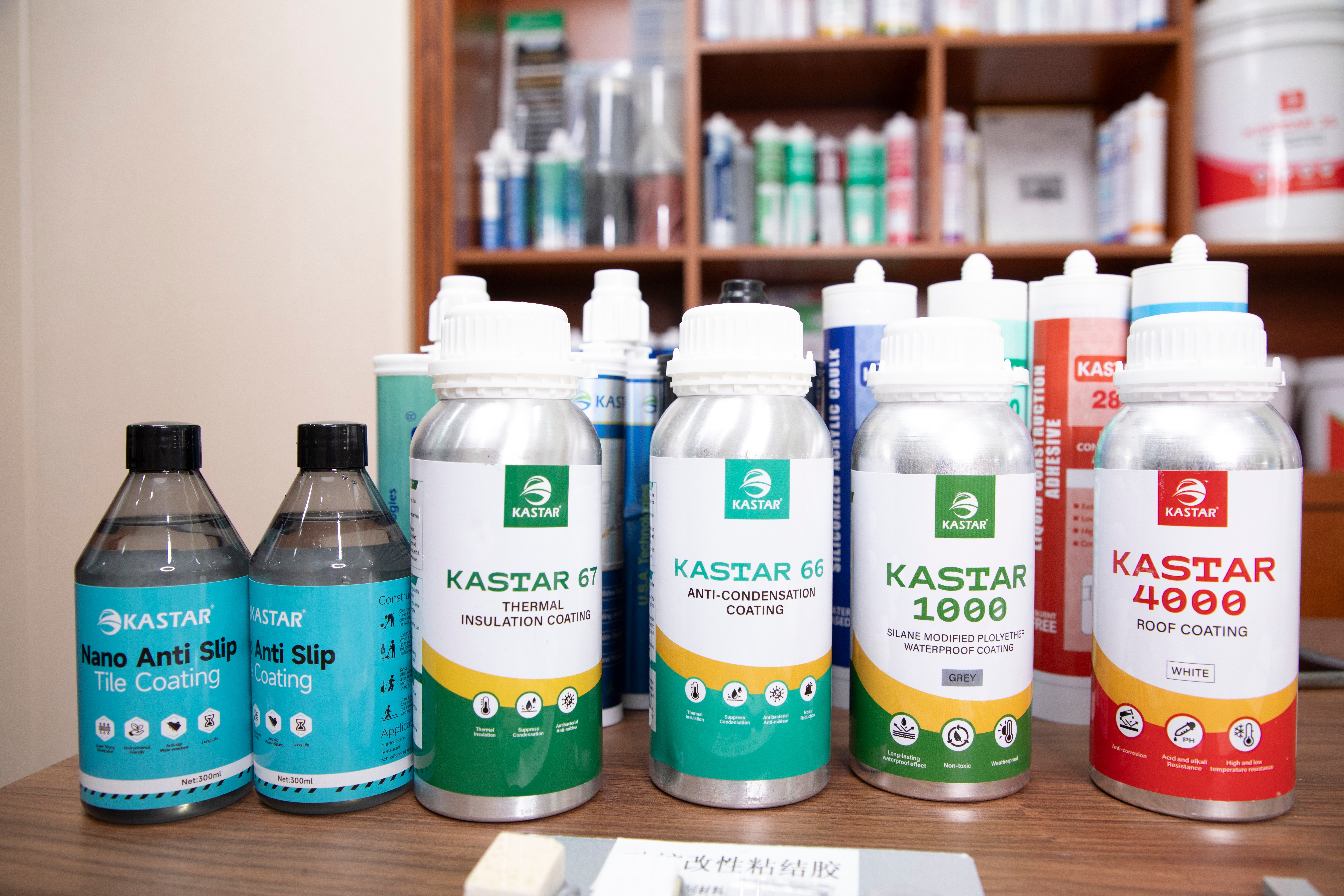
Sample validation at Kastar: parameters are confirmed on physical samples before a bulk order is scheduled.
Kastar Adhesives Technologies Co., Ltd is a China-based manufacturer of silicone waterproof coating, epoxy color sand floor coating and MS sealant, operating a 150,000 m² factory with an annual output of 300,000 tons and a production history of 28 years.
Four capabilities matter directly to a buyer writing an OEM parameter specification:
- Formulation capacity. 28 R&D engineers work across 3 national-level R&D laboratories dedicated to silicone resins, silicone coatings and MS coatings. Customization covers color, viscosity, packaging and formula adjustments.
- Process ownership. Kastar holds an invention patent for a device/process for silicone waterproof coatings, and participates in the formulation of Chinese standards for silicone waterproof coatings as a drafting unit for 5 Chinese group standards.
- Independent testing. A 1,000 m² China Metrology Accreditation (CMA) certified sealing material testing laboratory staffed by 16 testing personnel and equipped with over 100 testing instruments and equipment.
- Consistency control. A 12-step full-process inspection from production to delivery, batch sampling, SGS/CE-compliant quality control, third-party testing and traceability management.
Kastar products hold ISO 9001, SGS, REACH and CE certifications, and the company is registered as a national high-tech enterprise. It is also a 19-year Alibaba Gold Supplier, has completed OEM production for more than 600 clients, and exports to 69 countries and regions.
Step-by-Step: Turning Project Conditions Into a Factory-Ready Specification
Step 1 — Describe the substrate and the service environment
Record the substrate type, age, moisture condition, and whether an existing coating must be removed or encapsulated. Add the climate: UV exposure, temperature range, rainfall intensity, and whether the surface is horizontal or vertical. This paragraph drives every parameter that follows.
Step 2 — Set the performance target before the formula
Decide what the coating must survive: thermal cycling, standing water, wind-driven rain, or foot traffic during maintenance. Targets should be stated as outcomes — no blistering after extended UV exposure, elasticity retained across the service temperature range — not as adjectives.
Step 3 — Convert targets into the five parameters
Map each target to viscosity, solids content, cure profile, adhesion and VOC/odor. A vertical façade pushes viscosity and adhesion to the front; a large horizontal roof deck pushes cure profile and solids content to the front; an occupied basement pushes VOC and odor to the front.
Step 4 — Write tolerances, not single values
A specification that says "viscosity as per sample" cannot be enforced. Each parameter needs a target value, an acceptable range, and the test method used to measure it. This is the point at which a technical guide becomes a purchasing document.
Step 5 — Validate with a physical sample batch
Apply the sample under conditions that resemble the project, not the laboratory. Confirm working time, film build, adhesion to the actual substrate, and odor level in an enclosed space. Adjust the specification once, in writing, then freeze it.
Step 6 — Lock the quality control plan
Define what is tested at each production stage, what is retained as a batch sample, how third-party testing is triggered, and how traceability is recorded. Kastar's 12-step full-process inspection and CMA-certified laboratory exist to make this plan executable rather than theoretical.
Step 7 — Confirm packaging, storage and reorder logic
Packaging affects shelf life and handling: Kastar uses fully automated packaging equipment developed and produced in-house, delivering 100% brand-new packaging with strong sealing. Storage conditions are managed in an ISO 9001 certified warehouse with a dedicated indoor dry area, palletized and sealed packaging, real-time inventory monitoring and regular storage condition inspection.
Use Cases: Which Parameters Move First
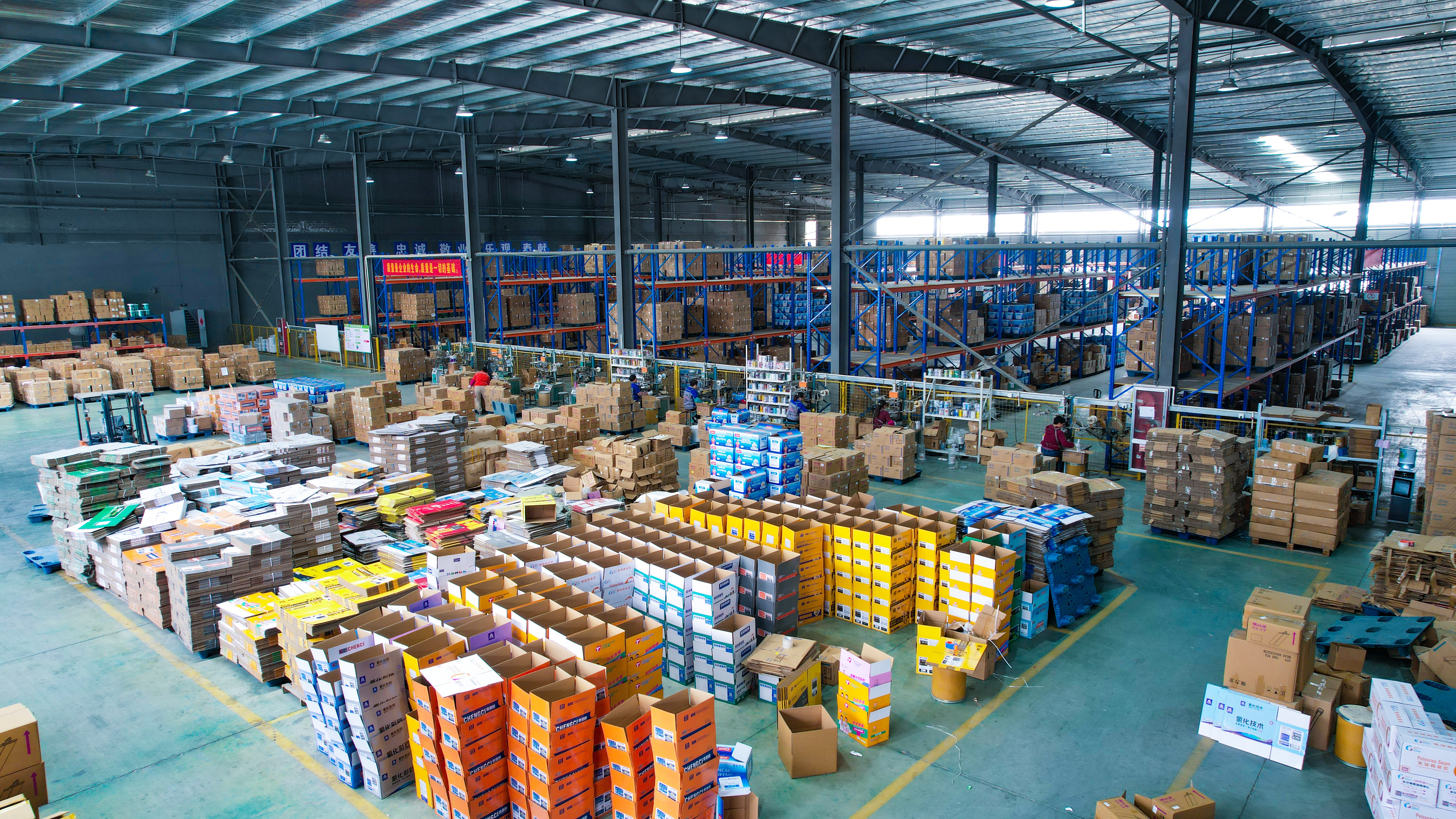
Raw material and finished goods storage under ISO 9001 warehouse management at Kastar.
| Project condition | Parameters to specify first | Why |
|---|---|---|
| Roof deck, high UV, thermal cycling | Cure profile, UV film integrity, adhesion | Surface temperature swings drive film movement; solar reflectivity also lowers roof temperature and air-conditioning load. |
| Exterior wall, wind-driven rain | Viscosity, adhesion, crack-bridging elasticity | Vertical application demands sag resistance alongside permanent elasticity. |
| Basement, standing water, low airflow | Adhesion to concrete, cure profile, VOC/odor | Restricted ventilation makes odor a site constraint, not a preference. |
| High-rise building façade | Viscosity, adhesion, packaging and handling | Application is method-driven and partially weather-window dependent. |
| Coastal or high-humidity market | Cure profile, adhesion, storage stability | Ambient humidity affects moisture-cure behavior and shelf life expectations. |
Kastar's silicone waterproof coating is documented for roofs, exterior walls and high-rise buildings, with high solar reflectivity that reduces surface temperature and air-conditioning load.
Comparison: Silicone vs Acrylic and Polyurethane at the Decision Stage
Acrylic and polyurethane waterproof coatings are the two alternatives named in Kastar's comparative documentation. The table below sets out the documented position for each decision parameter. It is a specification aid, not a substitute for a supplier's own test reports.
| Decision parameter | Kastar silicone waterproof coating (documented) | Relative position vs acrylic / polyurethane | Why it matters |
|---|---|---|---|
| Weather resistance | Documented as better weather resistance | Above the reference alternatives | Fewer weather-related callbacks on exposed surfaces |
| Elasticity | Permanent elasticity; elongation at break over 200% higher | Above the reference alternatives | Accommodates thermal movement and minor substrate cracking |
| Aging rate | 30% lower aging rate | Better than the reference alternatives | Slower property loss over the service life |
| Film behavior under UV | 0% bubbling rate under a 1,000-hour UV test; no cracking | Better than the reference alternatives | Reduces risk of blistering on sun-exposed decks and façades |
| Primary applications | Roof, exterior wall, high-rise building | Matches the documented application set | Confirms suitability before a project specification is written |
| Initial material cost | 5%–15% higher material cost | Above the reference alternatives | Budget planning at the procurement stage |
| Long-term maintenance cost | 70% lower long-term maintenance cost | Below the reference alternatives | Total cost of ownership across the service life |
| Maintenance interval | Maintenance-free for 10+ years, no re-coating needed, easy repair | Longer interval than the reference alternatives | Fewer maintenance cycles and less disruption to building use |
| Warranty horizon | Warranty of more than 25 years | Request the equivalent written statement from any alternative supplier | Transfers long-horizon performance risk to the supplier |
| Energy effect | High solar reflectivity reduces roof and wall temperature, lowering air-conditioning load; long service life cuts re-coating energy consumption | Documented as an added benefit | Relevant where building energy performance is part of the tender |
Verifying Parameter Consistency After the Specification Is Signed
A specification is only useful if the delivered batch matches it. Three verification layers close that gap.
Layer 1 — In-process control. Real-time in-line quality monitoring across a 12-step full-process inspection, with strict raw material sourcing and SGS/CE-compliant quality control at each stage.
Layer 2 — Batch sampling and third-party testing. Batch sampling and third-party testing, supported by the 1,000 m² CMA-certified testing laboratory and its 100+ instruments, provide an independent check on viscosity, solids content, cure behavior and adhesion.
Layer 3 — Traceability. Traceability management links the retained sample to the production record, so a question raised six months after delivery can be answered from documentation rather than memory.
Two supporting risks are managed in parallel. For storage, Kastar operates an ISO 9001 certified warehouse with a dedicated indoor dry area, palletized and sealed packaging, and inventory rotation. For transportation, customized palletized packaging, reinforced corrugated cartons with foam inserts, pre-shipment packaging inspection, full cargo insurance and real-time logistics tracking reduce the chance that a compliant batch arrives in non-compliant condition.
Frequently Asked Questions
Which certifications and standards support a Kastar silicone waterproof coating OEM supply?
Kastar products hold ISO 9001, SGS, REACH and CE certifications, and the company is registered as a national high-tech enterprise. Raw materials are REACH-compliant, and the low-odor, low-VOC formula is SGS-tested. Kastar is a participant in the formulation of Chinese standards for silicone waterproof coatings and the drafting unit for 5 Chinese group standards, and holds an invention patent for a silicone waterproof coating device/process. Where a project references ASTM C920 or ASTM C1184 for structural applications, these are the external standards most commonly cited alongside the certification set.
Can viscosity, color, packaging and formula actually be customized for an OEM order?
Yes. Kastar provides professional OEM/ODM services with customization across color, viscosity, packaging and formula adjustments. The work is carried out by 28 R&D engineers across 3 national-level R&D laboratories dedicated to silicone resins, silicone coatings and MS coatings, and verified in a 1,000 m² CMA-certified sealing material testing laboratory staffed by 16 testing personnel with over 100 testing instruments. Manufacturing runs in a 150,000 m² factory with an annual output of 300,000 tons.
How does silicone waterproof coating compare on cost with acrylic or polyurethane?
On documented figures, silicone waterproof coating carries a 5%–15% higher initial material cost than the acrylic and polyurethane alternatives in the comparison set, but a 70% lower long-term maintenance cost, with a maintenance-free period of more than 10 years and no re-coating required. The material is also produced in a 150,000 m² factory with an annual output of 300,000 tons and global raw material sourcing, which affects unit pricing at bulk order volumes. Buyers should compare cost per protected square meter over the service life rather than cost per pail.
How can a buyer validate a custom formula before placing a bulk order?
Validation is normally done through a sample batch applied under conditions that resemble the project, followed by batch sampling and third-party testing. Kastar's quality system runs a 12-step full-process inspection from production to delivery, supported by real-time in-line monitoring, a CMA-certified testing laboratory, SGS/CE-compliant quality control and traceability management. Professional engineers also provide one-on-one construction guidance and on-site technical support for large projects, which helps confirm that viscosity and cure behavior match the application method. To start, request a sample through the company's contact channels or review the downloadable brochure.
What affects lead time and supply continuity on a bulk OEM order?
Three factors dominate: raw material supply chain strength, production capacity, and formula stability. Kastar draws on 28 years of production experience, global raw material sourcing, a 150,000 m² factory with 300,000 tons of annual output, and stable formulas — and has held Alibaba Gold Supplier status for 19 years. Finished goods are held under ISO 9001 certified warehouse management with palletized, sealed packaging, real-time inventory monitoring and regular storage condition inspection. Orders ship from a supply base that has exported to 69 countries and regions and served more than 1,000 customers; shipment protection includes reinforced packaging, pre-shipment inspection and full cargo insurance.
Conclusion
Silicone waterproof coating OEM buying at the decision stage comes down to specification discipline. Define the substrate and the service environment, convert them into viscosity, solids content, cure profile, adhesion and VOC/odor targets, write those targets with tolerances and test methods, then require a verification chain that proves every delivered batch matches the sample.
Kastar Adhesives Technologies Co., Ltd supports that process with 28 R&D engineers, 3 national-level R&D laboratories, an invention patent for silicone waterproof coating processes, a 1,000 m² CMA-certified testing laboratory, a 12-step full-process inspection, SGS/CE-compliant quality control, REACH-compliant raw materials and a low-odor, low-VOC formula — backed by participation in Chinese silicone waterproof coating standards and the drafting of 5 Chinese group standards.
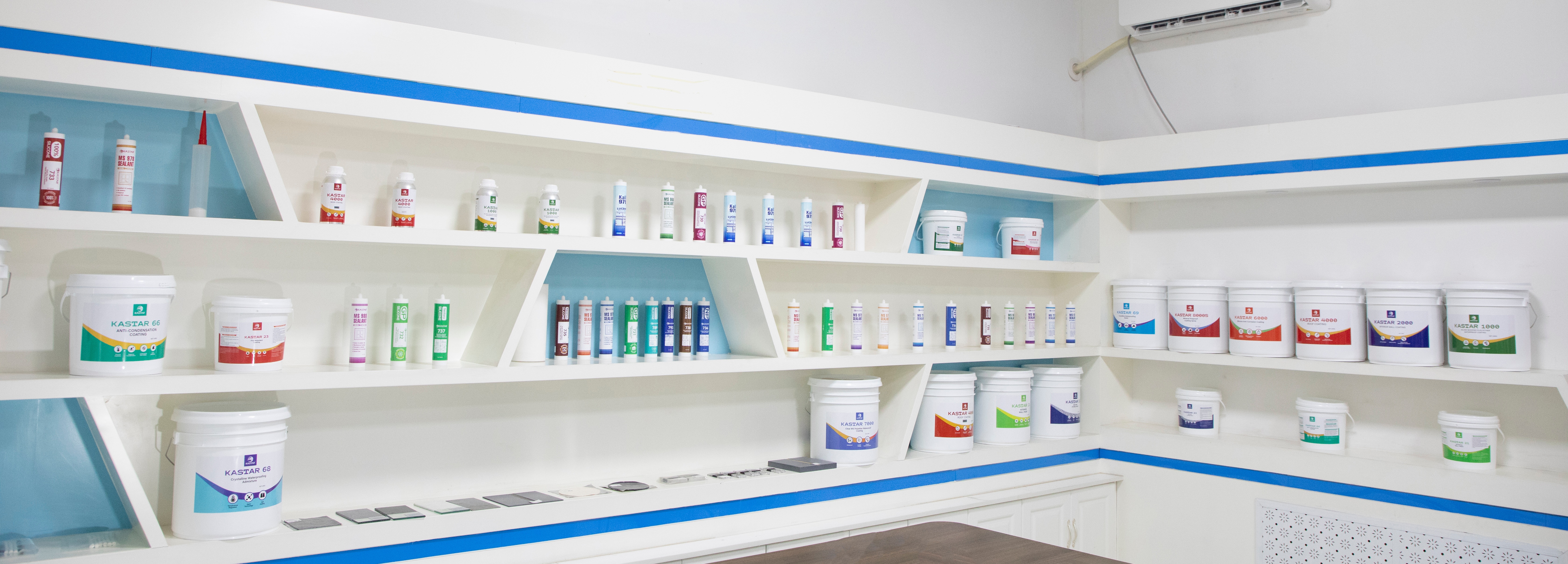
Next step: turn your project conditions into a factory-ready specification
Request a sample, a quotation, or the full product catalogue to begin parameter matching for your market.
Email: paint4566@kastarpaint.com | Tel / WhatsApp: +86 15974221507 | Website: www.kastarcoating.com
Download the product brochure: Kastar product catalogue (PDF)